
What's Happening?
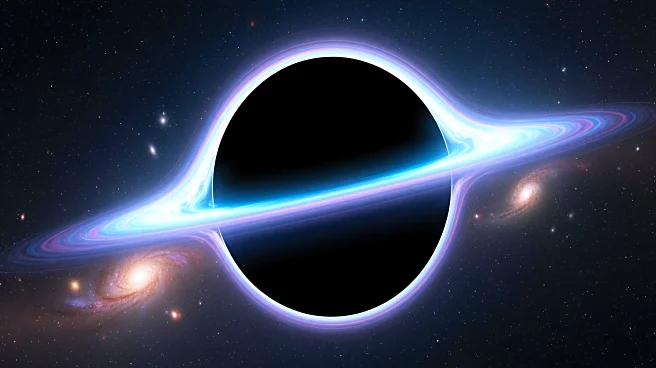
Astronomers have discovered a massive black hole, approximately 50 million times the mass of the sun, in a galaxy from 13 billion years ago, named Abell 2744-QSO1. This black hole, identified using the James Webb Space Telescope, is unusual because it
lacks surrounding stars, contradicting traditional theories that black holes form from collapsing stars. Researchers suggest it may be a primordial black hole, a concept first theorized by Stephen Hawking, which could have formed from density fluctuations shortly after the Big Bang. This discovery challenges existing models of black hole formation and suggests that primordial black holes might have survived and grown over billions of years.
Why It's Important?
The identification of a potential primordial black hole has significant implications for our understanding of the early universe and the formation of cosmic structures. If confirmed, it could provide evidence for alternative pathways of black hole formation, beyond the collapse of massive stars. This could reshape theories about the evolution of galaxies and the role of black holes in cosmic history. The discovery also underscores the capabilities of the James Webb Space Telescope in exploring the distant universe and uncovering phenomena that challenge established scientific paradigms.
What's Next?
Further research and more detailed simulations are needed to confirm the nature of the black hole in Abell 2744-QSO1. Scientists will likely conduct additional observations to gather more data on its properties and surrounding environment. This could involve looking for signs of high-energy radiation or other indicators that might support the primordial black hole hypothesis. The findings could prompt a reevaluation of current astrophysical models and inspire new theoretical work to better understand the conditions of the early universe.