

What's Happening?
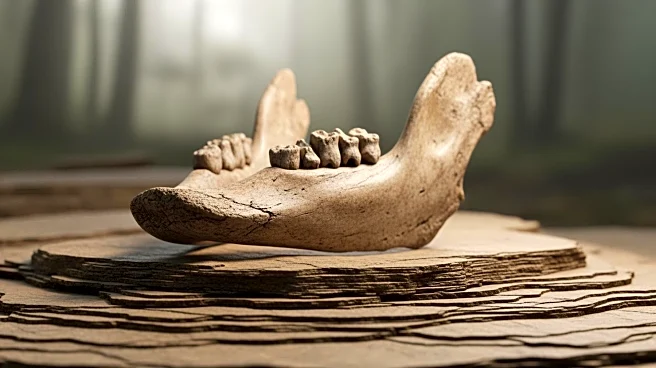
A newly discovered species, Tyrannoroter heberti, has been identified as one of the earliest known plant-eating land animals. The fossil, found in a tree stump on Cape Breton Island, Nova Scotia, dates back 307 million years. This discovery, detailed
in a study published in Nature Ecology & Evolution, suggests that herbivory among tetrapods began earlier than previously thought. The species, characterized by a heart-shaped skull and robust teeth, likely evolved from insect-eating ancestors, marking a significant dietary shift in early land ecosystems.
Why It's Important?
The discovery of Tyrannoroter heberti provides crucial insights into the evolution of herbivory among early land vertebrates. It suggests that plant-eating behaviors developed independently across different groups, not just among ancestors of modern reptiles. This finding challenges previous timelines and theories about the evolution of terrestrial ecosystems. Understanding these early dietary shifts is vital for comprehending the development of modern ecosystems, which are dominated by herbivores. The research also highlights the role of climate change in shaping ancient ecosystems, as shifts in climate may have influenced the survival and extinction of early herbivores.
Beyond the Headlines
The study of Tyrannoroter heberti opens new avenues for research into the evolution of early tetrapods and their adaptation to terrestrial life. The use of advanced technologies like 3D scanning and printing in paleontology allows for detailed analysis of fossils without risking damage. This approach could revolutionize how fossils are studied and shared globally. Additionally, the discovery underscores the dynamic nature of scientific understanding, as new findings continually reshape our knowledge of evolutionary history.