





What's Happening?
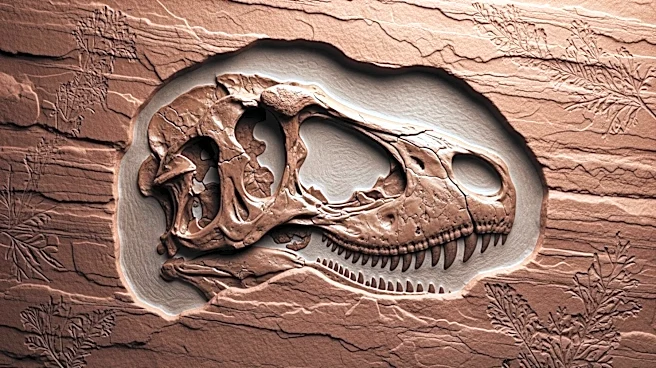
A new genus and species of carnivorous dinosaur, named Ptychotherates bucculentus, has been identified from a well-preserved skull found in northern New Mexico. This discovery, made by paleontologists Simba Srivastava and Sterling Nesbitt, provides significant
insights into the diversity of early dinosaurs during the Rhaetian stage of the latest Triassic period, approximately 201 million years ago. The fossil, discovered in the Coelophysis Quarry, features a mostly complete skull with a braincase and skull roof, indicating a dinosaur with a tall, narrow head and massive cheekbones. This species is part of the Herrerasauria family, one of the earliest-evolving groups of carnivorous dinosaurs, and is closely related to other Triassic dinosaurs like Tawa hallae and Chindesaurus bryansmalli. The findings suggest that some early dinosaur lineages persisted longer than previously thought, surviving until just before the end-Triassic extinction.
Why It's Important?
The discovery of Ptychotherates bucculentus challenges previous assumptions about the extinction of early dinosaur lineages. It suggests that some groups of early carnivorous dinosaurs survived longer than expected, particularly in the low-latitude regions of ancient Pangea, such as the American Southwest. This finding forces a reevaluation of the impact of the end-Triassic extinction, which was previously thought to have primarily affected non-dinosaur competitors. The presence of this species in the fossil record indicates that the extinction event may have also wiped out some long-standing dinosaur lineages. This discovery not only enriches the understanding of dinosaur evolution but also highlights the complexity of extinction events and their impact on biodiversity.
What's Next?
Further research and exploration in the Coelophysis Quarry and similar sites may uncover additional fossils that could provide more information about the diversity and distribution of early dinosaurs. Paleontologists may focus on understanding the environmental conditions that allowed these dinosaurs to survive longer in certain regions. Additionally, the study of Ptychotherates bucculentus and its relatives could lead to new insights into the evolutionary pathways of early theropods and their adaptation strategies. This research could also inform broader studies on the resilience of species to mass extinction events.