






What's Happening?
A new study by the Schneider Electric Research Institute (SERI) indicates that photovoltaic (PV) and battery energy storage systems could reduce total global electricity system costs by up to 40% in the 2030s. This significant cost reduction is contingent
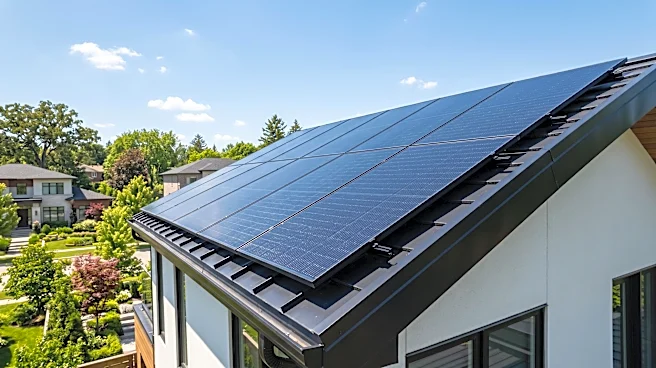
on lower installation costs for these technologies and a simultaneous growth in electricity demand. The report, 'System Costs of Electricity: A New Baseline for the 21st Century Economy,' analyzed 40,500 scenarios, evaluating the economic impact of large-scale adoption of distributed energy resources (DERs), particularly rooftop solar and batteries. While current global average installation costs show a 10% reduction, projected costs for the 2030s could lead to a 40% reduction, potentially adding 0.8% to global GDP. However, the study notes that results vary by market, with U.S. residential solar installation costs being about three times the global average, leading to higher system costs in the U.S. under current conditions.
Why It's Important?
This research highlights the immense economic potential of integrating solar PV and battery storage into the global electricity system. A 40% reduction in electricity costs could have transformative effects on economies worldwide, boosting GDP and improving affordability for consumers and businesses. The study emphasizes that coordinated growth in distributed generation, batteries, and electricity demand is crucial to realize these savings. This means that simply expanding solar and battery capacity in isolation is not enough; electrification of additional consumption sectors (like electric vehicles, heat pumps, and data centers) must advance concurrently. For the U.S., the higher installation costs present a challenge, indicating a need for policy interventions to streamline processes and reduce expenses to fully capitalize on these potential savings. The findings underscore the importance of strategic planning and policy support to synchronize supply expansion with demand growth.
What's Next?
To achieve these potential cost reductions, SERI identifies three key policy priorities. First, smoothing electricity demand through time-of-use tariffs, demand charges, and incentives for combining solar with batteries is essential. Second, synchronizing supply expansion with demand growth through incentives that combine DER investment with electrification, and building requirements that integrate these technologies. Third, developing supply chains and accelerating cost reductions through public procurement, manufacturing incentives, streamlined permitting, and workforce training. For the U.S., addressing the high residential solar installation costs will be critical. This could involve policy efforts to reduce soft costs, improve supply chain efficiency, and foster a more competitive market. The coordinated operation of these technologies and the development of new electricity loads will be vital for unlocking the full economic benefits in the coming decade.
Beyond the Headlines
The study's findings suggest a paradigm shift in electricity generation and consumption, moving towards a more decentralized, efficient, and cost-effective system. The emphasis on coordinated growth between supply and demand highlights the need for integrated energy planning that considers both technological deployment and consumer behavior. This could lead to innovative business models for utilities and energy providers, focusing on demand-side management and localized energy solutions. Ethically, ensuring equitable access to these cost savings and technologies across different socioeconomic groups will be important. Legally, regulatory frameworks will need to adapt to support distributed energy resources and smart grid technologies. Culturally, it signifies a broader societal embrace of sustainable energy practices, driven by both environmental consciousness and economic pragmatism, potentially accelerating the global transition to a low-carbon economy.