



What's Happening?
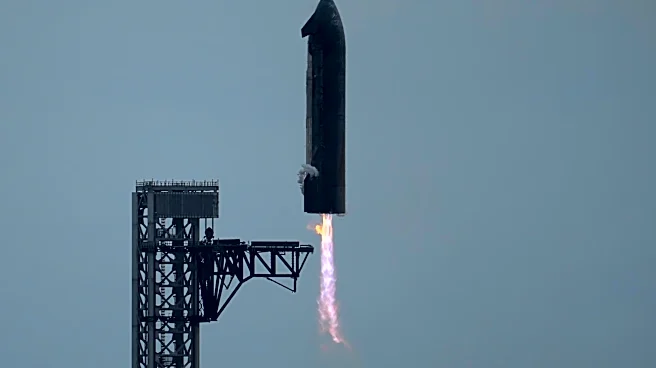
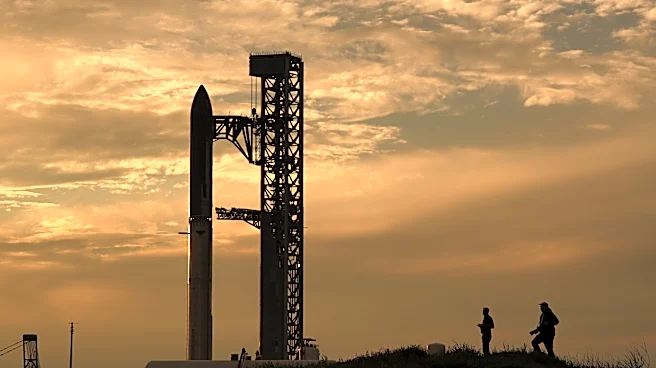
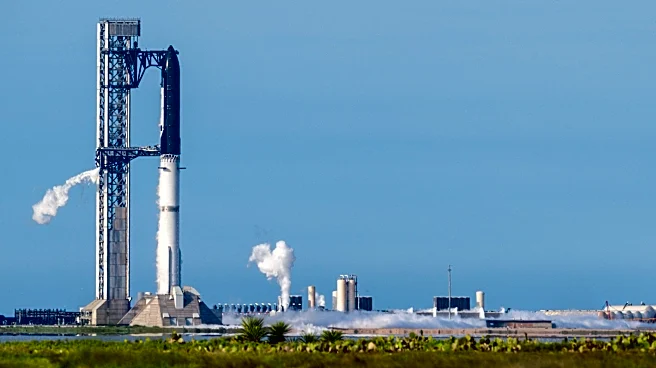
On November 14, 2026, SpaceX achieved a significant milestone by successfully catching the upper stage of its Starship rocket, designated Ship 42, with mechanical arms at its Starbase launch tower in Boca Chica, Texas. This event marked the first time
an orbital upper-stage spacecraft has returned from space and been caught at its launch site. The Starship completed 14 orbits at an altitude of approximately 265 kilometers (165 miles) over 22 hours before re-entering Earth's atmosphere and being precisely maneuvered into the 'Mechazilla' mechanical arms. However, the mission was not without incident; the first-stage Super Heavy booster exploded over the Gulf of Mexico after an early low-fuel warning caused it to abandon its planned landing at the launch tower. Despite the booster's failure, the successful capture of the upper stage is considered a major advancement in SpaceX's goal of developing a fully reusable space transportation system.
Why It's Important?
The successful mid-air capture of the Starship upper stage is a critical step towards achieving full reusability in spaceflight, a core objective for SpaceX. This capability is expected to dramatically reduce launch costs and increase the frequency of space missions, making space access more affordable and scalable. Lowering the cost of launching satellites and transporting large-scale space cargo is vital for various industries, including telecommunications, scientific research, and defense. Furthermore, this advancement is crucial for supporting NASA's Artemis lunar program, which aims to land astronauts on the Moon. The ability to rapidly refurbish and reuse spacecraft is seen as essential for future human exploration of the Moon and Mars, potentially transforming the economics and accessibility of space travel.
What's Next?
SpaceX is currently investigating the precise cause of the first-stage booster's failure, which was attributed to an early low-fuel warning that led to the abandonment of its planned tower landing. Future missions will likely focus on refining the booster recovery process to achieve full reusability for both stages of the Starship system. The company aims to integrate the lessons learned from this incident into its design and operational procedures to enhance reliability and safety. The successful capture of the upper stage will allow SpaceX to proceed with refurbishing Ship 42 for subsequent flights, further validating its reusable technology. Continued progress in this area will be closely watched by aerospace engineers and space agencies globally, as it holds the potential to reshape the future of space exploration and commercial space operations.
Beyond the Headlines
The achievement of catching the Starship upper stage in mid-air represents a paradigm shift in aerospace engineering, moving beyond traditional single-use rocket designs. This development highlights a broader trend towards innovation and risk-taking in the private space sector, challenging conventional approaches to space travel. The concept of 'rapid reusability' could fundamentally alter the economic model of space exploration, making ambitious projects like establishing lunar bases or Martian colonies more feasible. Ethically, this progress raises questions about the long-term environmental impact of increased launch frequency and the responsible management of space debris. Culturally, it reinforces the idea of human ingenuity and perseverance in overcoming complex technical challenges, inspiring a new generation of scientists and engineers to pursue careers in space-related fields.