




What's Happening?
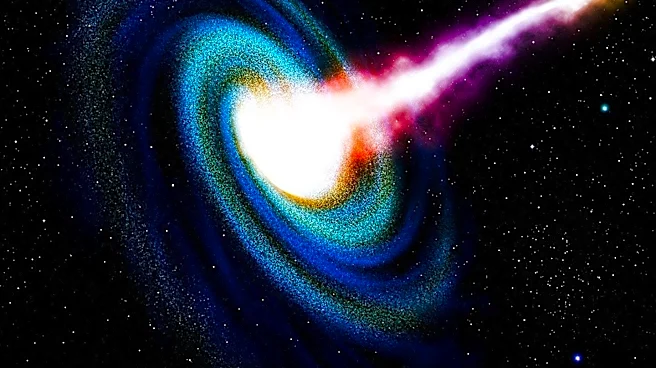
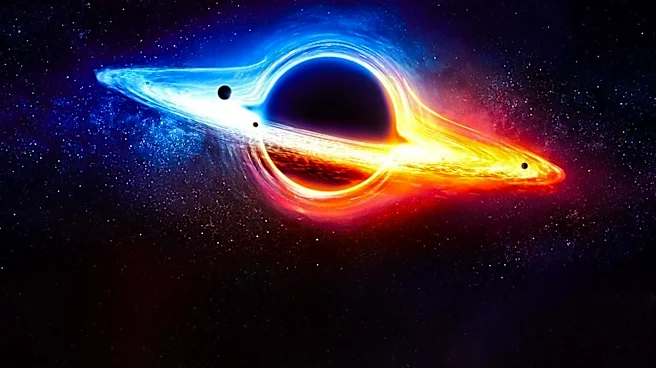
Astrophysicists at Syracuse University have proposed a new explanation for why repeated flares from stars interacting with supermassive black holes grow progressively dimmer. These events, known as repeating partial tidal disruption events (rpTDEs), occur
when a star makes multiple close passes to a black hole, losing some of its mass and producing a flare of light each time. Previous theoretical models struggled to explain the observed dimming of successive flares. The new study, published in The Astrophysical Journal, suggests that a star's rapid initial spin, prior to its first encounter with the black hole, is the crucial 'new ingredient.' This rapid initial spin prevents the star from being significantly spun up during subsequent close encounters, which in turn keeps the timescale for material fallback relatively constant. As less material is lost with each encounter, the peak fallback rate and thus the flare's brightness decline.
Why It's Important?
This research provides a significant advancement in understanding the complex dynamics between stars and supermassive black holes. The dimming of rpTDE flares has been a puzzling observation, and this new model offers a coherent explanation, improving the accuracy of astrophysical simulations. Understanding these interactions is crucial for indirectly studying supermassive black holes, which do not emit light themselves but become visible through the energy released during TDEs. The findings also shed light on the origins of stars in extreme environments, such as those orbiting Sagittarius A*, the supermassive black hole at the center of the Milky Way. By explaining the dimming phenomenon, scientists can better interpret observational data from wide-field time-domain surveys, leading to a more precise understanding of black hole properties and stellar evolution in galactic centers.
What's Next?
The proposed model suggests that the rapid initial spin of the star is key. Researchers will likely focus on further investigating the mechanisms that could lead to such rapid stellar rotation, with the Hills mechanism being a prime candidate. This mechanism posits that a binary star system passing near a supermassive black hole can be torn apart, with one star captured into a tight orbit and tidally locked, resulting in rapid spin. Future observational studies will aim to identify more rpTDEs and gather more detailed data on their dimming patterns to further validate this model. Additionally, the findings could influence how astronomers interpret the properties of stars in the vicinity of other supermassive black holes, potentially leading to a re-evaluation of existing data and a deeper understanding of our own galactic center.
Beyond the Headlines
This study delves into the extreme physics governing the most massive objects in the universe. The concept of a star being 'spun up' by a black hole's tidal forces, and how its initial rotation dictates its subsequent interactions, highlights the intricate dance between gravity and stellar mechanics. It underscores the importance of seemingly minor details, like a star's spin, in shaping cosmic phenomena. The research also touches upon the broader implications of binary star systems and their role in populating the regions around supermassive black holes. This work not only advances our understanding of black holes but also provides a window into the violent yet formative processes that occur in the hearts of galaxies, revealing how stars can survive, albeit altered, in such hostile environments.