



What's Happening?
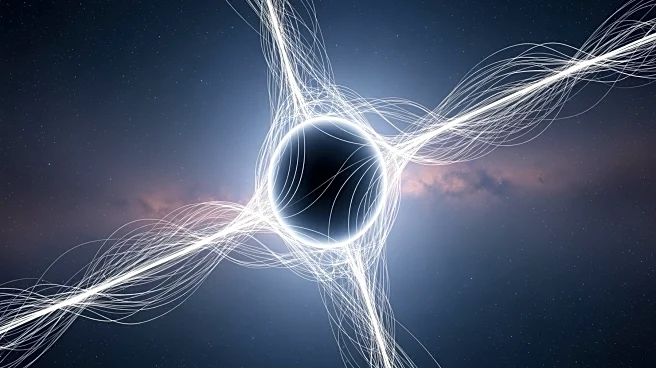
An international team of researchers has found evidence suggesting that dark matter and neutrinos, often referred to as 'ghost particles,' may interact by colliding and transferring momentum. This discovery, published in the journal Nature Astronomy,
could address longstanding issues in the standard model of cosmology, particularly the 'S8 tension,' which refers to a discrepancy between the expected and observed 'clumpiness' of the universe. Dark matter, which makes up 85% of the universe's matter, and neutrinos, subatomic particles with very low mass, have been difficult to study due to their elusive nature. The study suggests that these interactions could explain why the universe is less densely populated by galaxies than previously predicted.
Why It's Important?
The potential interaction between dark matter and neutrinos could lead to a significant revision of the lambda-CDM model, the prevailing cosmological model that explains the large-scale structure of the universe. If confirmed, this interaction could provide insights into the formation of cosmic structures and help resolve the S8 tension, which has puzzled scientists for years. The findings could also influence future research directions in cosmology and particle physics, potentially leading to a deeper understanding of the universe's evolution. This discovery could impact theoretical models and observational strategies, prompting a reevaluation of how cosmic structures are formed and distributed.
What's Next?
Further research is needed to confirm the interaction between dark matter and neutrinos. Upcoming large sky surveys, such as those from the Vera C. Rubin Observatory, along with more precise theoretical work, will be crucial in determining the validity of these findings. If the interaction is confirmed, it could represent a fundamental breakthrough in cosmology and particle physics, offering a new perspective on the dark sector of the universe. Researchers will continue to analyze data from various telescopes and surveys to refine their models and explore the implications of this potential interaction.