







What's Happening?
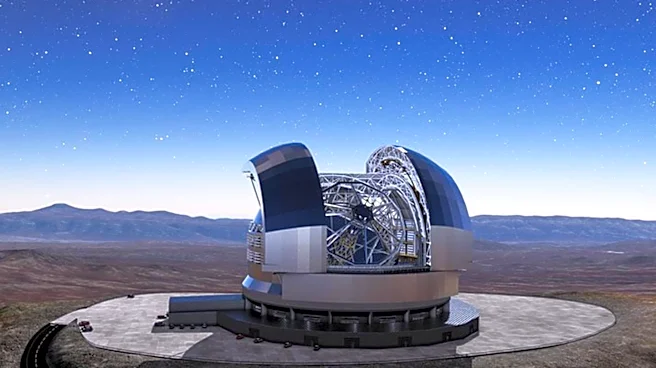
The Vera C. Rubin Observatory in Chile has commenced the Legacy Survey of Space and Time (LSST), a decade-long project aimed at capturing detailed images of the southern sky. The observatory's camera, the largest digital camera in the world, will take
thousands of images every night, creating a time-lapse panorama of intergalactic evolution. This survey will allow scientists to study rare and difficult-to-detect cosmic events, such as supernovae and black holes, and contribute to the understanding of dark matter and dark energy. The project is jointly funded by the US National Science Foundation and the Department of Energy.
Why It's Important?
The LSST represents a significant advancement in astronomical research, providing an unprecedented amount of data on the universe. By capturing a comprehensive view of the southern sky, the survey will help scientists create a new inventory of the solar system and the Milky Way. The data collected will be accessible to both scientists and the public, opening the door to new discoveries and collaborations. The project aims to address fundamental questions about the universe, including the nature of dark matter and dark energy, which are critical to understanding the universe's structure and evolution.
What's Next?
As the survey progresses, the observatory will continue to capture and analyze data, with the goal of identifying new celestial objects and phenomena. The use of AI and machine learning will be integral in processing the vast amount of data and detecting notable changes over time. The observatory plans to issue regular data releases, allowing researchers worldwide to access and study the findings. The LSST is expected to generate millions of alerts each night, highlighting interesting movements and events in the cosmos, and contributing to a deeper understanding of the universe.