




What's Happening?
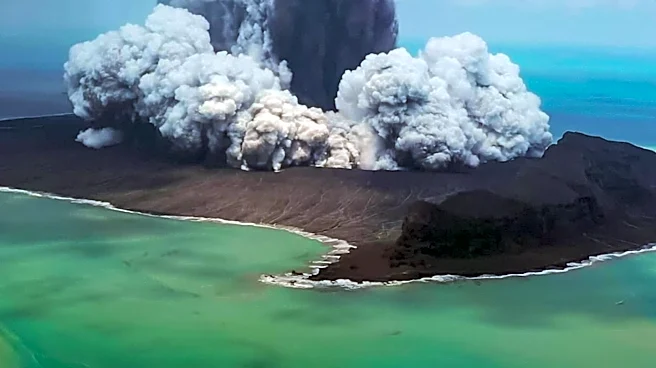
A volcanologist, Professor Bill McGuire, has issued a warning about the potential for a 'megatsunami' that could devastate the U.S. East Coast. This catastrophic event is linked to the unstable Cumbre Vieja volcano on La Palma in Spain's Canary Islands.
Professor McGuire's theory suggests that if a flank of this volcano collapses into the Atlantic Ocean, it could trigger a massive tsunami with waves potentially reaching 65 feet high. Computer simulations indicate that such waves could impact East Coast communities within nine hours of the collapse. The danger stems not from typical volcanic hazards like ash or lava, but from the sheer volume of rock displacing ocean water. The flank of Cumbre Vieja has been slowly moving since an eruption in 1949, inching towards the sea at a rate of one to two centimeters per year, according to McGuire's team's findings from the 1990s.
Why It's Important?
The potential for a megatsunami originating from the Canary Islands poses a significant, albeit long-term, threat to the U.S. East Coast. Such an event could lead to widespread destruction of coastal infrastructure, massive loss of life, and severe economic disruption in major population centers. The warning highlights the vulnerability of densely populated coastal regions to natural disasters that may seem geographically distant. While the exact timing is uncertain—potentially centuries or millennia away—the scientific assessment underscores the need for long-term disaster preparedness and coastal resilience planning. The economic impact could be immense, affecting industries from tourism and shipping to real estate and insurance, potentially leading to a reevaluation of coastal development policies and emergency response strategies across multiple states.
What's Next?
While Professor McGuire emphasizes the unpredictability of the event, stating it could be centuries or millennia away, the scientific community continues to monitor active volcanoes like Cumbre Vieja. Further research and monitoring efforts will likely focus on understanding the stability of the volcano's flanks and refining tsunami prediction models. For U.S. coastal communities, the warning may prompt discussions on long-term hazard mitigation, including infrastructure reinforcement, improved early warning systems, and public education campaigns. Although immediate action may not be required due to the extended timeline, the scientific assessment serves as a critical input for future urban planning and disaster preparedness strategies, potentially influencing policy decisions regarding coastal development and emergency response protocols.
Beyond the Headlines
The discussion around a potential megatsunami from the Canary Islands raises profound questions about humanity's long-term vulnerability to natural geological processes. It highlights the ethical dilemma of planning for events that are highly improbable in the short term but potentially catastrophic in the long term. The scientific debate surrounding the likelihood of such a transatlantic tsunami, as acknowledged by McGuire, underscores the complexities of geological forecasting and the challenges in communicating low-probability, high-impact risks to the public and policymakers. This scenario also touches upon the cultural and psychological aspects of living with distant, yet existential, threats, potentially influencing how societies perceive and prepare for future environmental challenges on a global scale.