





What's Happening?
Senator John Hoeven has unveiled a two-part plan designed to protect upstream farmers whose land may be impacted by the Fargo-Moorhead flood diversion project. The first component of this plan involves the establishment of a $25 million crop loss program
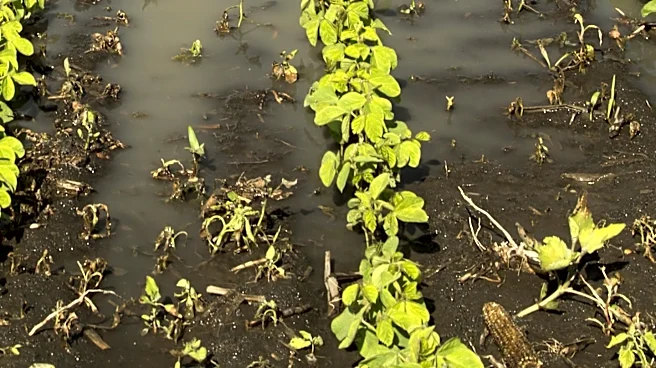
by the Metro Flood Diversion Authority. This program aims to provide 100% coverage for damaged crops and match prevented planting coverage. The funding for this initiative is sourced from $100 million in U.S. Army Corps of Engineers project savings, which Senator Hoeven secured. The second part of the plan addresses long-term impacts by including a provision in the Senate Farm Bill. This provision will exclude flood-impacted years from a producer’s Actual Production History, a measure intended to prevent reduced yields from leading to increased future crop insurance premium costs. According to Senator Hoeven, the goal is to ensure that crop insurance remains an effective risk management tool for these farmers.
Why It's Important?
This two-part plan is crucial for safeguarding the economic stability of agricultural communities in the Fargo-Moorhead region, particularly those located upstream of the flood diversion project. Standard federal crop insurance typically covers natural disasters, but not man-made flood control operations, leaving farmers vulnerable to significant financial losses. By establishing a dedicated crop loss program with 100% coverage, the plan directly addresses this gap, ensuring that producers are compensated for damaged crops and prevented planting. Furthermore, the inclusion of a provision in the Senate Farm Bill to exclude flood-impacted years from Actual Production History is vital for the long-term viability of these farming operations. Without this measure, repeated flood events could artificially lower a farmer's historical yield data, leading to higher insurance premiums and making future crop insurance less affordable and effective. This initiative underscores the importance of tailored federal and local solutions to protect agricultural stakeholders from the unintended consequences of large-scale infrastructure projects.
What's Next?
The immediate next step involves the Metro Flood Diversion Authority implementing the $25 million crop loss program, which will provide direct financial relief to affected farmers. Concurrently, the provision introduced by Senator Hoeven in the Senate Farm Bill will need to navigate the legislative process. Its successful inclusion and passage in the final Farm Bill will be critical for establishing the long-term protection mechanism for farmers' Actual Production History. Local officials, such as Fargo Mayor Josh Boschee, have emphasized the collaborative effort with landowners in shaping this agreement, suggesting ongoing engagement will be necessary for its effective implementation. The focus will be on ensuring that the mechanisms for compensation and long-term insurance adjustments are clearly communicated and accessible to all eligible producers, allowing them to plan for future planting seasons with greater certainty.
Beyond the Headlines
Beyond the immediate financial and legislative measures, this plan highlights a broader challenge in infrastructure development: balancing regional benefits with localized impacts. The Fargo-Moorhead flood diversion project, while designed to protect urban areas, creates a new set of risks for upstream agricultural lands. This situation underscores the need for comprehensive impact assessments and proactive mitigation strategies that consider all affected stakeholders, not just those directly benefiting from the primary project. The reliance on both local funding and federal legislative fixes demonstrates a multi-faceted approach to problem-solving, potentially setting a precedent for how similar large-scale projects might address collateral damage in the future. It also brings to light the evolving nature of agricultural risk management, where traditional insurance models may need to adapt to new forms of man-made environmental alterations, ensuring that the agricultural sector remains resilient in the face of complex challenges.