


What's Happening?
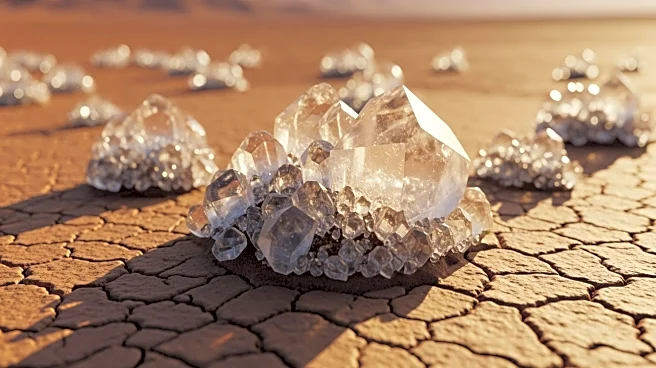
Researchers have discovered that translucent crystals in the Atacama Desert, one of Earth's driest regions, may hold microbial traces that could inform the search for past life on Mars. The Atacama Desert's conditions are similar to those on ancient Mars,
making it an ideal analog for studying potential life-preserving environments. The crystals, specifically gypsum, have been found to preserve microbial life by shielding it from harsh conditions. This discovery suggests that similar crystals on Mars could have preserved evidence of past life.
Why It's Important?
This research is significant as it provides a potential method for detecting past life on Mars by examining similar mineral structures. The findings highlight the importance of gypsum as a natural shield and time capsule for biological material, offering insights into how life could be preserved in extreme environments. This could guide future Mars missions in identifying promising sites for life detection, potentially reshaping our understanding of the planet's history and its capacity to support life.
What's Next?
Future Mars missions may focus on areas with gypsum deposits to search for preserved microbial life. The study reinforces the need for continued exploration of Mars-like environments on Earth to refine techniques for detecting life. As technology advances, more sophisticated instruments could be developed to analyze these mineral structures both on Earth and Mars, enhancing our ability to uncover signs of past life.
Beyond the Headlines
The study underscores the broader implications of using Earth analogs to understand extraterrestrial environments. It also raises questions about the preservation of life in extreme conditions and the potential for similar processes to occur on other planets. This research could influence astrobiology and the search for life beyond Earth, encouraging a multidisciplinary approach to exploring the universe.