
What's Happening?
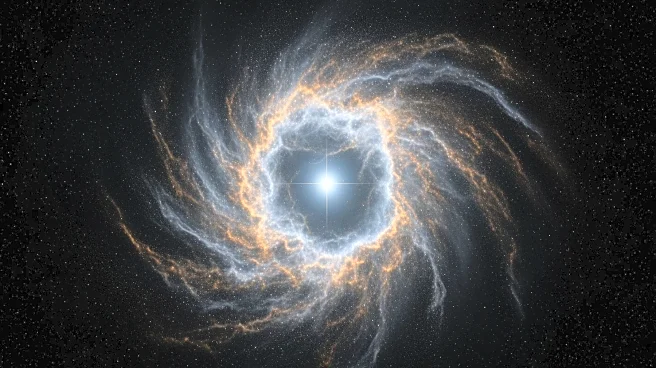
Astronomers from Johns Hopkins University have identified a massive cloud of gas and dust that obscured the Sun-like star J0705+0612 for nine months. Located approximately 3,000 light years from Earth,
this cloud is composed of evaporated metals and is held together by the gravitational pull of an unknown massive object, potentially a giant planet or a low-mass star. The discovery, published in The Astronomical Journal, was made using data from the Gemini South, Apache Point, and Magellan telescopes. The cloud, about 200 million kilometers wide, caused the star to dim significantly, an event that began in September 2024 and lasted until May 2025. Spectral observations revealed the presence of heavy elements like iron and calcium, and for the first time, scientists were able to measure the motion of these gases within the cloud.
Why It's Important?
This discovery is significant as it provides new insights into the dynamics of mature planetary systems. The presence of such a large cloud of evaporated metals suggests that even in systems that are billions of years old, dramatic events like planetary collisions can occur. This challenges previous assumptions about the stability of older star systems and highlights the ongoing processes of creation and destruction in the universe. The ability to measure the motion of gases within the cloud also represents a technological advancement in astronomical observations, potentially paving the way for further discoveries about the composition and behavior of similar cosmic structures.
What's Next?
Future research will likely focus on identifying the massive object responsible for holding the cloud together. Determining whether it is a giant planet or a low-mass star could provide further insights into the formation and evolution of planetary systems. Additionally, astronomers may continue to monitor the star J0705+0612 and similar systems to observe any further changes or events, which could offer more data on the frequency and impact of such collisions in the universe.
Beyond the Headlines
The discovery underscores the dynamic nature of the universe, where even seemingly stable systems can undergo significant changes. It also raises questions about the potential for similar events in our own solar system's past and how they might have shaped its current configuration. The findings could influence theories about planetary formation and the lifecycle of star systems, prompting a reevaluation of how we understand the evolution of celestial bodies over time.