





What's Happening?
Joshua Tree National Park features distinctive boulder formations, which are the result of a complex geological history involving granitic rock. These formations, often appearing as enormous stones balanced against each other with smooth curves and straight
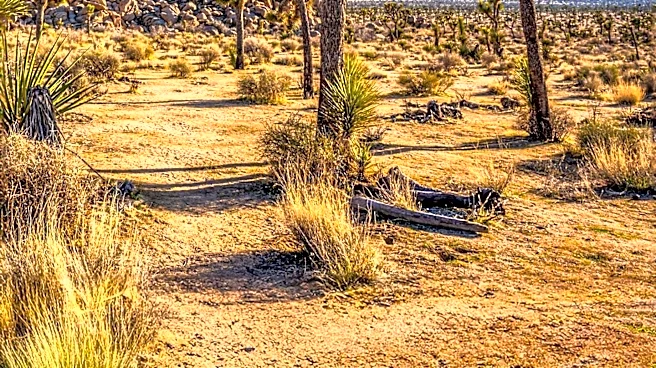
cracks, began as buried, fractured granitic rock. Water played a crucial role in altering the rock around harder cores through a process known as spheroidal weathering. This process involves water penetrating fractures in the rock, changing minerals into softer material, and loosening grains. Erosion subsequently removed the loosened material, leaving behind the more resistant, rounded cores as the visible boulders. The park's terrain combines desert ecosystems, exposed granite monoliths, rugged canyons, and higher mountain country, all shaped by these geological forces.
Why It's Important?
Understanding the geological processes that shaped Joshua Tree National Park's rock formations is crucial for appreciating the park's unique landscape and its broader significance in geological studies. The park serves as a natural laboratory for observing the effects of underground weathering, erosion, and uplift on granitic rock. This knowledge helps scientists and visitors alike comprehend how vast landscapes are formed over millions of years, illustrating the dynamic nature of Earth's crust. The distinctive appearance of these rocks also contributes significantly to the park's aesthetic appeal, drawing tourists and outdoor enthusiasts, which in turn supports local economies and promotes conservation efforts. The geological history also informs park management strategies, particularly in areas like climbing routes, where rock stability and environmental impact are key considerations.
What's Next?
Ongoing geological research and educational initiatives will continue to deepen the understanding of Joshua Tree National Park's rock formations. The National Park Service and affiliated organizations regularly update information and provide resources for visitors to learn about the park's geology. Future interpretive programs and signage will likely incorporate the latest scientific findings to enhance the visitor experience. Additionally, as climate patterns shift, monitoring the effects of changing weather on these formations will be important for long-term preservation. The park's unique geology will continue to attract researchers and educators, potentially leading to new discoveries about weathering processes and desert geomorphology, further solidifying its role as a significant site for earth science education and research.
Beyond the Headlines
The seemingly static rock formations of Joshua Tree National Park tell a profound story of continuous change and the immense power of natural forces. Beyond their scientific value, these geological features hold cultural and aesthetic significance, inspiring artists, photographers, and spiritual seekers. The concept of 'spheroidal weathering' and the distinction between rock age and landscape age offer a deeper perspective on geological time, challenging human perceptions of permanence. The park's landscape, with its 'impossibly placed' boulders, encourages visitors to look beyond the surface and consider the hidden processes that shape our world. This interaction with ancient, dynamic geology fosters a sense of humility and connection to the Earth's deep history, enriching the human experience of nature.