






What's Happening?
Shirley, Massachusetts, recently honored one of its most renowned former residents, Benton MacKaye, with a 'Talk and Walk' event. MacKaye, celebrated for his contributions to environmental protection and outdoor recreation, is best known as the visionary
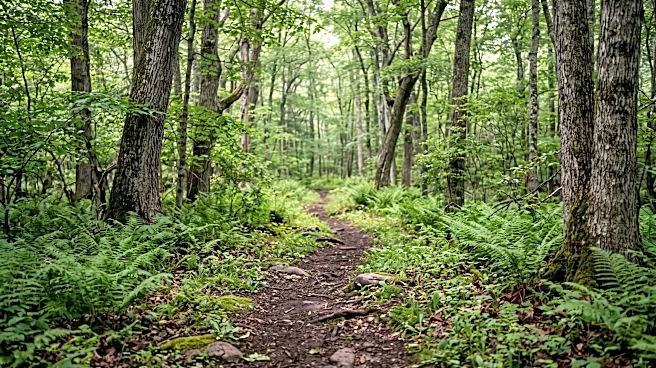
who proposed the Appalachian Trail. In 1921, he put forth the idea of a continuous hiking trail stretching from Maine to Georgia, which led to the opening of the first section in October 1923 and the completion of the entire footpath in 1937. As a boy, MacKaye explored Shirley's rivers, swamps, and forests, meticulously documenting the local flora and fauna. His belief in the necessity of wilderness access for human well-being—to relax and rejuvenate body, mind, and spirit—was a driving force behind his work. On October 10, thirty individuals gathered at the Shirley Historical Society Museum to learn about MacKaye's legacy before embarking on a walk along paths he would have frequented. Faith Salter, Executive Director of North County Land Trust, led the hike, with additional support and information provided by the Shirley Greenway Committee. MacKaye was also a co-founder of the Wilderness Society in 1935 and played a role in creating Shirley's first Conservation Plan in 1971.
Why It's Important?
Benton MacKaye's legacy is profoundly important for U.S. environmental policy and outdoor recreation. His vision for the Appalachian Trail not only created one of the world's most famous long-distance hiking paths but also laid foundational principles for wilderness preservation and public access to nature. The Appalachian Trail, a national scenic trail, continues to serve as a vital resource for recreation, conservation, and environmental education, attracting millions of visitors annually and contributing to local economies along its route. MacKaye's involvement in the Wilderness Society further solidified his influence on the conservation movement, advocating for the protection of wild lands across the nation. His local efforts in Shirley, such as contributing to the town's first Conservation Plan, demonstrate how his broader environmental philosophy translated into tangible community-level action. This event in Shirley serves to remind the public of the historical roots of the U.S. conservation movement and the enduring impact of individuals like MacKaye on shaping the nation's natural landscape and recreational opportunities.
What's Next?
The Shirley Historical Society Museum will continue to offer information on Benton MacKaye and maps of local trails, encouraging residents and visitors to explore the natural areas that shaped his early environmental consciousness. The Shirley Greenway Committee and North County Land Trust are likely to continue their efforts in promoting local conservation and outdoor activities, building upon MacKaye's legacy. Such events help to foster community engagement in environmental stewardship and appreciation for local history. The ongoing availability of resources and organized walks ensures that MacKaye's contributions to both local and national conservation efforts remain relevant and accessible to future generations. These initiatives also serve to educate the public about the importance of preserving natural spaces and the benefits of outdoor recreation, aligning with MacKaye's original philosophy.
Beyond the Headlines
Benton MacKaye's life and work offer a deeper insight into the philosophical underpinnings of the American conservation movement. His belief that access to wilderness was essential for human well-being—for mental, physical, and spiritual rejuvenation—was revolutionary for its time and remains highly relevant today. In an increasingly urbanized and technologically driven society, MacKaye's advocacy for 'time and space to explore nearby wilderness areas' speaks to the ongoing need for nature connection. His work transcends mere trail building; it represents a holistic approach to human-environment interaction, emphasizing the restorative power of nature. The event in Shirley not only celebrates a local hero but also reinforces the enduring value of his ideas in contemporary discussions about public health, urban planning, and environmental ethics. MacKaye's legacy encourages a re-evaluation of how communities integrate natural spaces into their development and how individuals can find balance and solace in the natural world.