
What's Happening?
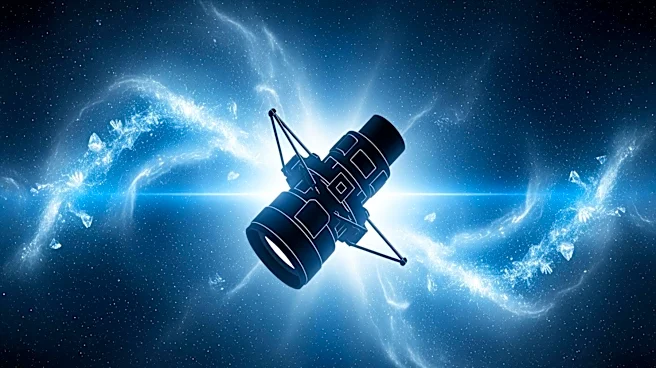
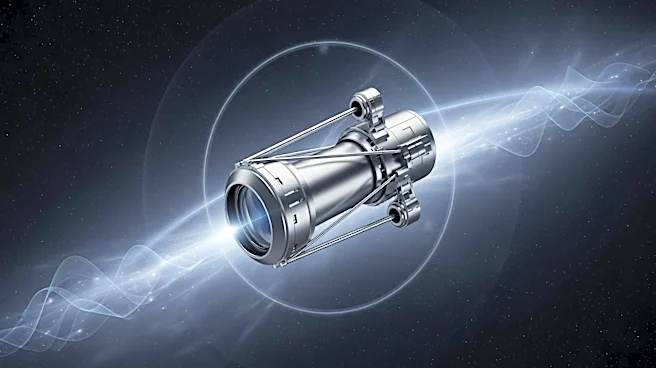
NASA's upcoming Nancy Grace Roman Space Telescope is set to explore the universe's dark side by studying weak gravitational lensing. This phenomenon occurs when massive objects like galaxy clusters warp
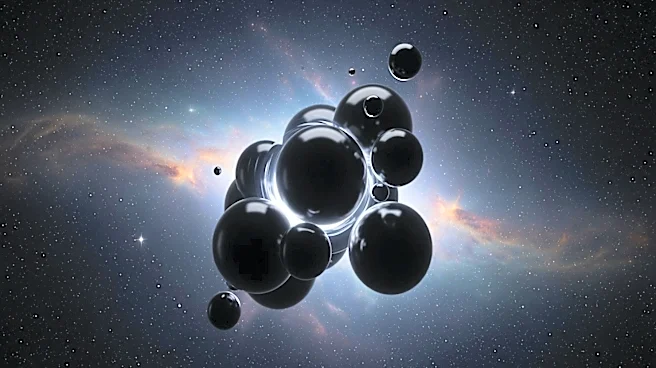
space-time, bending the path of light from distant galaxies. Roman's sensitivity will allow it to map the distribution of both visible and dark matter across the universe. By analyzing these distortions, scientists aim to gain insights into dark matter, which interacts with normal matter only through gravity. The telescope will also contribute to understanding dark energy, which accelerates the universe's expansion. Roman's observations will complement those from other telescopes, such as ESA's Euclid and the Vera C. Rubin Observatory, enhancing the accuracy of cosmic measurements.
Why It's Important?
The Roman Space Telescope's mission is crucial for advancing our understanding of the universe's fundamental components—dark matter and dark energy. By mapping these elements, Roman will help scientists unravel the mysteries of cosmic evolution and the forces shaping the universe. The data collected will provide a more detailed picture of how structures have formed since the Big Bang. This research could lead to breakthroughs in physics, potentially revealing the nature of dark matter and the mechanisms behind dark energy. The collaboration with other telescopes will ensure comprehensive data analysis, improving the precision of cosmological models and theories.
What's Next?
As the Roman Space Telescope prepares for its mission, scientists are developing techniques to analyze the data it will collect. The collaboration with other observatories will be key in cross-verifying findings and refining measurement techniques. Once operational, Roman will begin its survey of the universe, with results expected to enhance our understanding of cosmic phenomena significantly. The scientific community anticipates that Roman's findings will prompt new research questions and potentially lead to the development of new theories in astrophysics.