


What's Happening?
Several members of the Kennedy family have filed to join a court case aimed at preventing President Trump from constructing a proposed triumphal arch in Washington. The arch, envisioned as a 250-foot structure featuring a 60-foot gold winged female figure
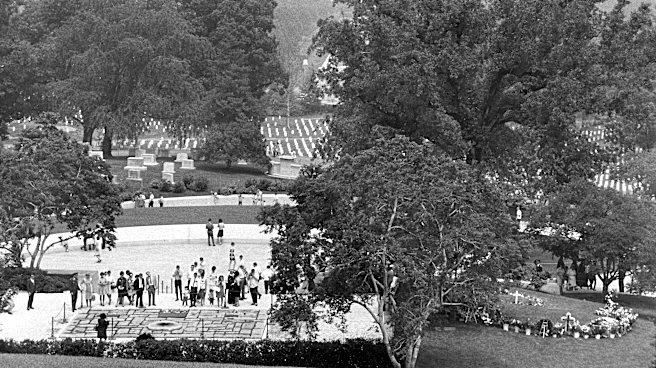
holding a flame and flanked by gold flying eagles, would be located across the Potomac River from the Lincoln Memorial, near the entrance to Arlington National Cemetery. The Kennedy family argues that this arch would permanently obstruct views and cast shadows over historically significant sight lines to their relatives' grave sites and memorials within Arlington National Cemetery, as well as those of hundreds of thousands of other fallen American heroes. A judge has already issued a temporary order halting construction until November 19, while considering a preliminary injunction. The Trump administration contends that Congress approved the arch over a century ago, alongside authorization for a bridge across the Potomac River, and states that the arch is intended to honor veterans.
Why It's Important?
This legal challenge highlights a significant clash between historical preservation, national remembrance, and contemporary development plans. The Kennedy family's involvement underscores the deep emotional and symbolic value placed on Arlington National Cemetery as a sacred burial ground for U.S. service members and prominent figures. The potential obstruction of sight lines and casting of shadows over grave sites could be seen as disrespectful to the deceased and their families, potentially eroding public trust in how national memorials are managed. Furthermore, the dispute raises questions about the interpretation of historical congressional approvals and the balance of power between executive actions and judicial oversight in matters of national heritage. The outcome could set a precedent for future development projects near sensitive historical and memorial sites, influencing how such projects are vetted and approved, and potentially impacting the sanctity of national cemeteries.
What's Next?
A judge has already issued a temporary order blocking construction of the arch through November 19, as she deliberates on whether to issue a preliminary injunction. This injunction, if granted, would further delay or potentially halt the project indefinitely. Numerous Democrats in Congress have also vowed to block construction once they assume control in January, following their victories in the November midterm elections. This indicates that even if the court challenge is overcome, the project could face significant legislative hurdles. The White House has not yet responded to requests for comment regarding the Kennedy family's legal action. The ongoing legal proceedings and potential congressional opposition suggest a protracted battle over the arch's future, with its fate likely to be determined by both judicial rulings and political will.
Beyond the Headlines
The controversy surrounding President Trump's proposed arch extends beyond mere aesthetics or property rights; it touches upon the very essence of national identity and how the U.S. chooses to honor its past. The Kennedy family, a prominent political dynasty with deep ties to American history, particularly through former President John F. Kennedy, brings considerable symbolic weight to the opposition. Their argument about the sanctity of Arlington National Cemetery and the respect owed to those interred there resonates with a broad segment of the public. This dispute could ignite a wider national conversation about the appropriate scale and nature of monuments, the preservation of historical landscapes, and the role of political figures in shaping national memory. It also implicitly questions the balance between honoring veterans and potentially imposing new structures that might alter established commemorative spaces, raising ethical considerations about legacy and remembrance.