
What's Happening?
Ukraine's President, Volodymyr Zelensky, has indicated a willingness to forgo Ukraine's pursuit of NATO membership in exchange for security guarantees from Western allies, including the United States.
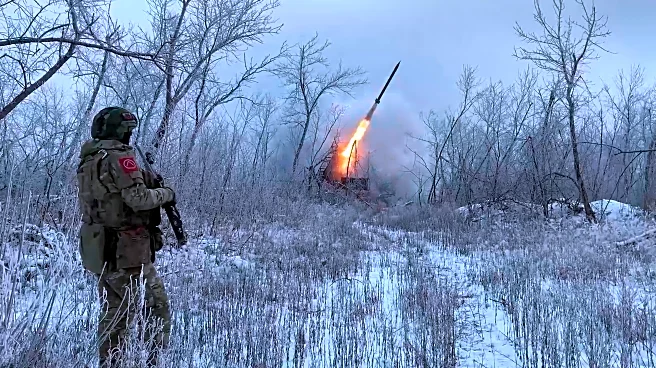
This development comes as part of ongoing peace negotiations aimed at ending the conflict in Eastern Europe, which has persisted for nearly four years. Historically, Ukraine has viewed NATO membership as a critical component of its national security strategy, particularly in deterring further Russian aggression. However, Russia has consistently opposed Ukraine's NATO aspirations, advocating instead for Ukrainian neutrality. Zelensky's proposal involves securing bilateral security guarantees akin to NATO's Article 5, which commits members to collective defense, from countries such as the U.S., Canada, Japan, and European nations. This shift in strategy underscores the complexity of the peace talks, where security assurances remain a contentious issue. The backdrop to these negotiations includes Russia's annexation of Crimea in 2014 and its support for separatists in Eastern Ukraine, followed by a full-scale invasion in February 2022.
Why It's Important?
Zelensky's potential concession marks a significant shift in Ukraine's foreign policy, reflecting the challenging geopolitical landscape and the urgent need for a sustainable peace agreement. By prioritizing security guarantees over NATO membership, Ukraine seeks to address immediate security concerns while navigating the diplomatic impasse with Russia. This move could reshape the security architecture in Eastern Europe, influencing the strategic calculations of NATO and its member states. For the U.S. and its allies, providing security guarantees to Ukraine could entail increased military and diplomatic commitments, potentially escalating tensions with Russia. Conversely, it may also open new avenues for dialogue and conflict resolution. The outcome of these negotiations will have profound implications for regional stability, U.S.-Russia relations, and the broader international order.
What's Next?
As peace talks progress, the focus will likely shift to the specifics of the proposed security guarantees and the mechanisms for their implementation. Key stakeholders, including the U.S., European nations, and Russia, will need to engage in complex negotiations to define the terms of these guarantees and ensure their enforceability. The international community will closely monitor these developments, as the success or failure of the talks could set a precedent for conflict resolution in other regions. Additionally, domestic political dynamics in Ukraine and Russia may influence the negotiation process, with potential implications for the leadership of both countries. The evolving situation will require careful diplomatic maneuvering to balance the interests of all parties involved.