





What's Happening?
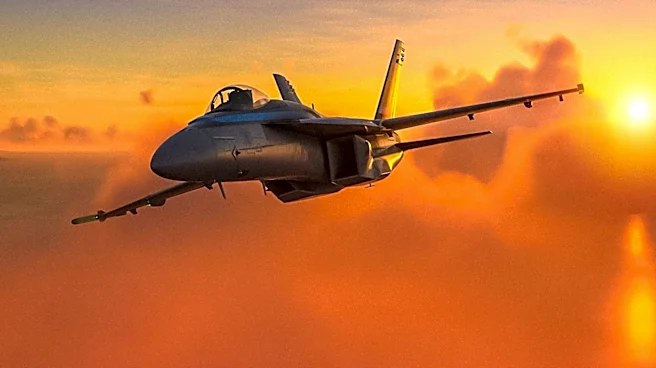
Newly released bodycam footage shows a U.S. Marine Corps pilot encountering local authorities after safely ejecting from an F/A-18 Hornet that crashed in Washington state two months prior. The incident occurred on June 13 during a routine training exercise,
when the pilot, assigned to Marine Aircraft Group 11, 3rd Marine Aircraft Wing, ejected from the aircraft. The F/A-18 Hornet crashed into a mountainside near Rimrock Lake in Yakima County, sparking a wildfire. The pilot, with a bloody face, emerged from a wooded area and was met by a law enforcement officer from the Yakima County Sheriff’s Office. He expressed extreme fortune to be alive, stating, 'That's about as close as it gets.' The footage also shows the retrieval of the pilot's oxygen mask and parachute, and paramedics later treated him for minor lacerations.
Why It's Important?
This incident underscores the inherent dangers and high-stakes nature of military aviation training, even for experienced pilots. The pilot's survival after ejecting from a crashing F/A-18 Hornet highlights the effectiveness of modern ejection systems and rapid response protocols in saving lives during critical aviation mishaps. The subsequent wildfire caused by the crash also brings to light the potential environmental impact of such incidents, particularly in forested or dry regions. For the U.S. Marine Corps, the event prompts an ongoing investigation into the cause of the crash, which is crucial for identifying any systemic issues, improving safety procedures, and preventing future occurrences. The pilot's account provides valuable real-world data for aviation safety and emergency response training.
What's Next?
The cause of the F/A-18 Hornet crash remains under investigation by the 3rd Marine Aircraft Wing. This investigation will likely involve analyzing flight data recorders, interviewing the pilot and witnesses, and examining the crash site to determine the factors that led to the aviation mishap. The findings of this investigation will be critical for implementing any necessary changes to training protocols, aircraft maintenance, or operational procedures to enhance safety. Additionally, efforts will continue to manage and mitigate the environmental impact of the wildfire sparked by the crash. The pilot, having sustained minor injuries, will likely undergo further medical evaluation and debriefing as part of the standard post-incident procedures.
Beyond the Headlines
Beyond the immediate details of the crash, this event touches upon broader themes of military readiness, technological reliability, and human resilience. The F/A-18 Hornet, a cornerstone of U.S. naval aviation, represents significant investment in defense technology, and any incident involving such an asset prompts scrutiny of its operational integrity. The pilot's survival, despite the severity of the crash, speaks to the rigorous training and advanced safety equipment provided to military personnel. Furthermore, the bodycam footage offers a rare, unfiltered glimpse into the immediate aftermath of a military aircraft accident, providing a human perspective on the dangers faced by service members and the critical role of first responders in such emergencies.