







What's Happening?
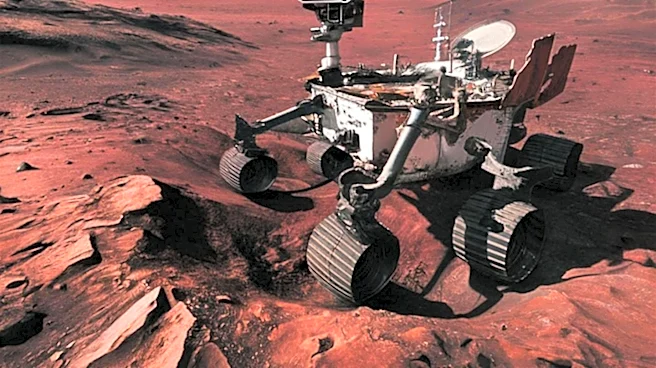
NASA's Curiosity rover has identified over 20 carbon-based molecules in a 3.5-billion-year-old clay-rich rock from Gale Crater on Mars. Among these, a nitrogen-bearing ring structure was found, which is linked to prebiotic chemistry. This discovery, published
in Nature Communications, suggests that ancient Martian sediments can preserve complex organic chemistry for billions of years. The findings do not confirm life on Mars but indicate that organic molecules can survive under harsh Martian conditions, providing valuable insights into the planet's past environment.
Why It's Important?
The discovery of complex organic molecules on Mars is significant for understanding the planet's potential to have supported life. While the presence of these molecules does not prove biological activity, it highlights the preservation of organic chemistry in Martian sediments. This finding aids future missions in targeting areas where organic matter might be preserved, enhancing the search for signs of past life. It also contributes to our understanding of how organic molecules can survive in extreme environments, informing astrobiology and planetary science.
What's Next?
Future missions, such as ESA's Rosalind Franklin rover and NASA's Dragonfly mission to Titan, will benefit from these findings by refining their search for organic matter. These missions aim to explore subsurface environments where organic molecules might be better preserved. The ongoing analysis of Martian samples will continue to provide insights into the planet's geological and chemical history, potentially guiding the search for life beyond Earth.