



What's Happening?
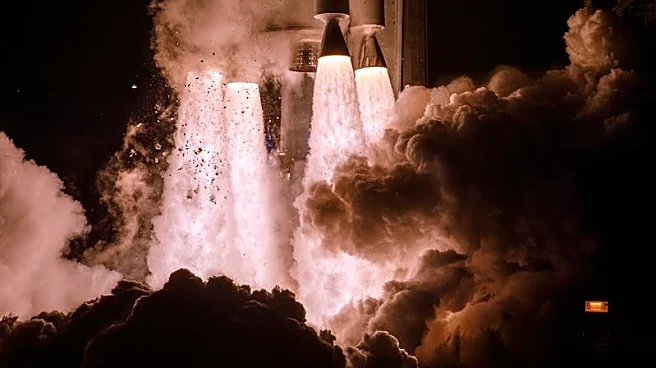
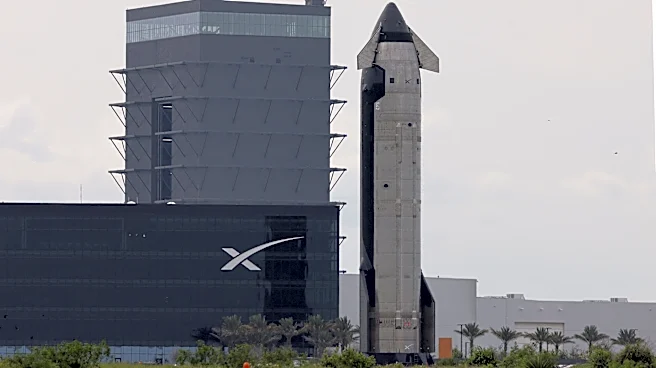
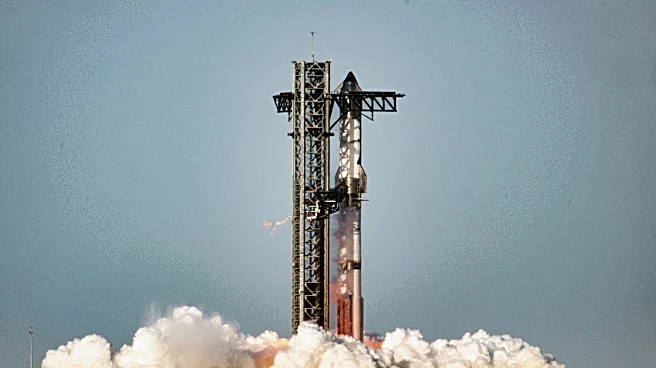
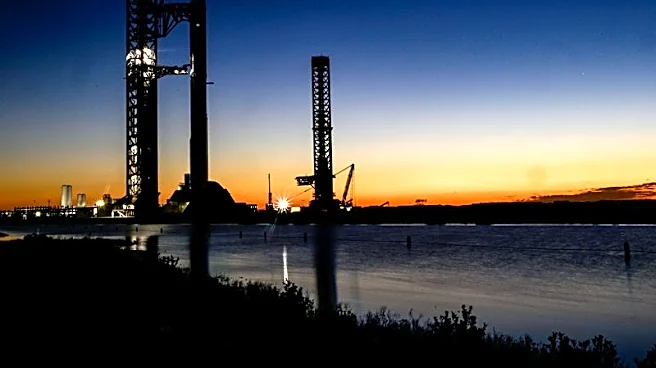
SpaceX's latest Starship test flight saw its first-stage booster explode in the Gulf of Mexico on Friday, November 13, 2026, preventing a planned 'double catch' recovery. Despite this setback, the Starship spacecraft successfully reached orbit, marking
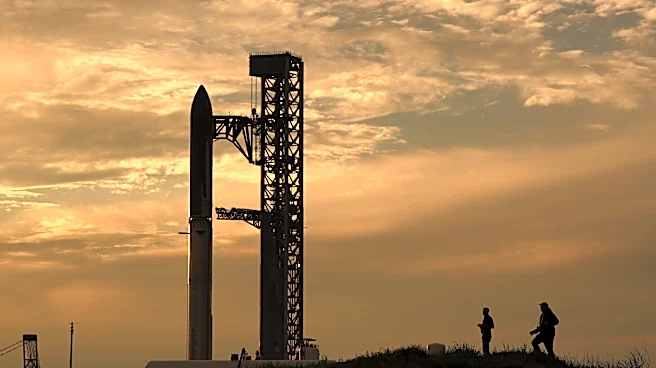
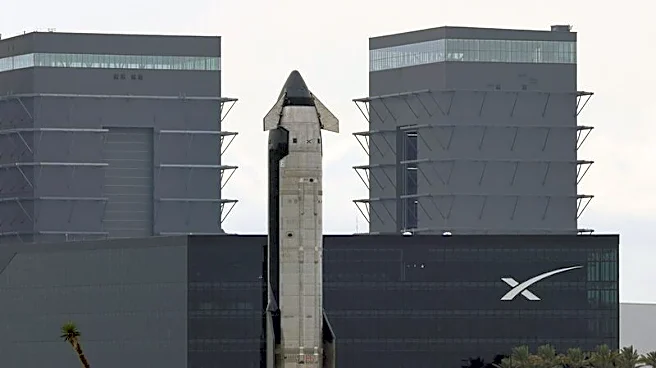
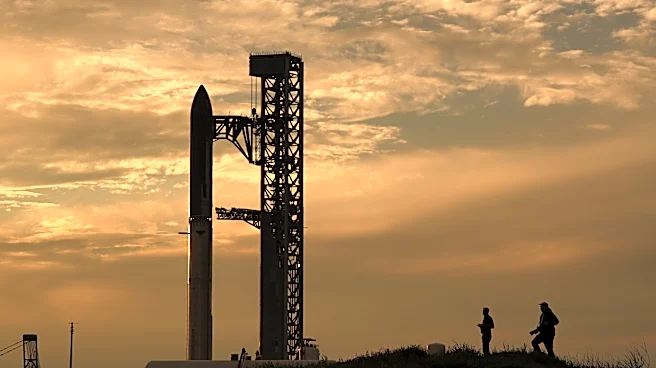
its boldest test flight to date. The booster, known as Super Heavy, was intended to return to the launch pad at Starbase, Texas, and be caught by mechanical arms. However, due to a detected guidance issue, the booster aborted its landing attempt and was diverted offshore, where it detonated its flight termination system. SpaceX launch commentator Kate Tice acknowledged the unexpected outcome, stating that it was consistent with rigorous safety checks. The spacecraft, meanwhile, continued its mission, deploying 26 advanced Starlink satellites and planning to complete 15 laps around the world before attempting its own return to the launch pad on Saturday.
Why It's Important?
This incident highlights the significant challenges and risks inherent in SpaceX's ambitious goal of full rocket reusability. The ability to recover and reuse both stages of the Starship rocket is central to Elon Musk's vision for rapid and consistent launch rates, which are deemed necessary for establishing moon bases and sending humans to Mars. While the booster's failure to return to the pad is a setback for the 'double catch' objective, the successful orbital insertion of the spacecraft demonstrates progress in Starship's development. The incident also underscores the complexity of the guidance and navigation control (GNC) systems required for such precise maneuvers, even as SpaceX clarified that the GNC system itself performed as intended by triggering the abort. The outcome will likely inform future design and operational adjustments as SpaceX continues to refine its Starship program.
What's Next?
The Starship spacecraft is scheduled to attempt its own return to the launch pad on Saturday, November 14, 2026, aiming for a mid-air catch by mechanical arms. This would be the first time the spacecraft portion of Starship attempts such a recovery from orbit. SpaceX is currently investigating the root cause of the booster's abort and subsequent explosion. Future plans include launching Starships from Florida within months and Louisiana within years, with the ultimate goal of replacing the smaller Falcon rockets. NASA is also a key stakeholder, having contracted SpaceX to use Starships for landing Artemis astronauts on the moon, with a decision expected a year before the Artemis IV lunar landing on whether to use Starship or Blue Origin's Blue Moon.
Beyond the Headlines
The pursuit of full rocket reusability, as exemplified by SpaceX's Starship program, represents a paradigm shift in space exploration. Achieving this goal could drastically reduce the cost of space launches, making missions to the moon and Mars more economically viable and frequent. The 'double catch' attempt, though unsuccessful in this instance, illustrates the innovative engineering approaches being explored to achieve this reusability. The incident also brings to light the inherent risks and iterative nature of developing cutting-edge space technology, where failures in test flights provide crucial data for future improvements. The long-term implications extend to the potential for a more accessible and sustainable space economy, impacting not only government space agencies but also commercial ventures and the broader scientific community.