
What's Happening?
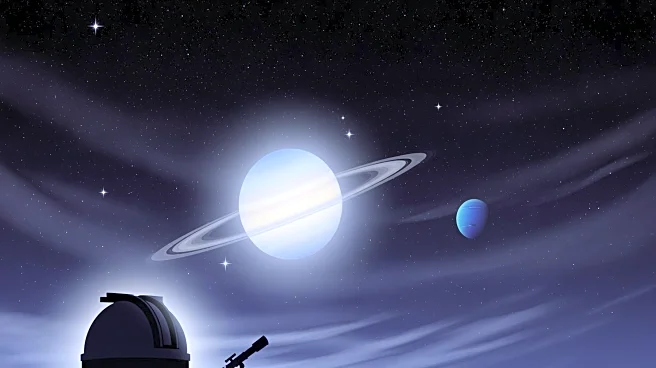
Throughout January, Saturn serves as a guide for locating Neptune in the night sky. Stargazers can use Saturn, visible near the Circlet of Pisces, to find Neptune by scanning 3.5° northeast of the ringed
planet. Neptune, with a magnitude of 7.8, appears as a small bluish disk and requires optical aid to view. As the month progresses, Saturn will move closer to Neptune, reducing their angular separation from 3.5° to 1.7° by the end of January. This celestial event offers an opportunity for astronomy enthusiasts to observe the solar system's most distant planet.
Why It's Important?
This alignment provides a unique opportunity for amateur astronomers and sky watchers to observe Neptune, which is typically challenging to locate due to its distance and faintness. Using Saturn as a reference point simplifies the process, making it accessible to those with binoculars or small telescopes. Observing such planetary alignments can enhance public interest in astronomy and provide educational opportunities about the solar system's structure and dynamics.