






What's Happening?
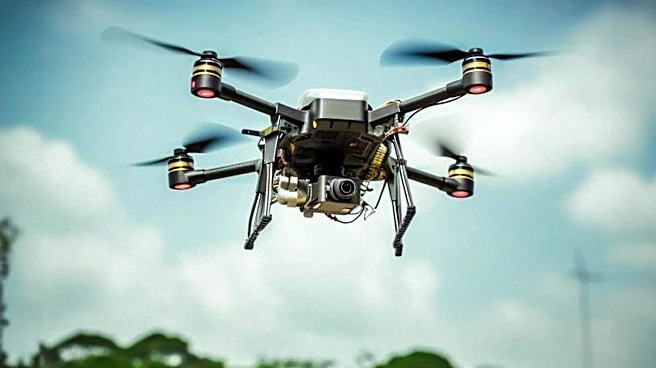
Zemene Kassie, leader of the Fano militia, has accused the Ethiopian federal government of using drones supplied by the UAE and Turkiye to attack civilian areas in Amhara and Tigray. Kassie's claims are supported by a report from the European Council
on Foreign Relations (ECFR) titled 'Deadly skies: Drone warfare in Ethiopia and the future of conflict in Africa.' According to the ECFR report, these drone attacks have resulted in civilian casualties and damage to public infrastructure, including schools and monasteries. Kassie asserts that the Fano militia is fighting for the 'total removal' of Prime Minister Abiy Ahmed's regime, believing that no political settlement is possible as long as Abiy remains in power. He also claims to have united various opposition forces across Ethiopia against the federal government.
Why It's Important?
This development is important as it highlights the severe humanitarian impact of drone warfare in ongoing conflicts, particularly on civilian populations and critical infrastructure. The ECFR report's findings lend credibility to the accusations of indiscriminate targeting, raising significant concerns about international humanitarian law and the conduct of armed conflict. The alleged use of drones supplied by the UAE and Turkiye also brings an international dimension to the conflict, potentially implicating these nations in human rights abuses if their equipment is used to target civilians. For the U.S., this situation presents a complex foreign policy challenge, as it involves regional stability in the Horn of Africa, human rights considerations, and the actions of allied nations. The accusations could lead to calls for international investigations, sanctions, or a re-evaluation of military aid and diplomatic relations with the involved parties.
What's Next?
The accusations and the ECFR report are likely to intensify international scrutiny on the conflict in Ethiopia and the use of drones. There may be increased pressure from international bodies and human rights organizations for independent investigations into the alleged civilian casualties and destruction of infrastructure. The U.S. and other international actors might face calls to review their relationships with the UAE and Turkiye regarding military sales and support, especially concerning drone technology. Domestically, the Fano militia's stated goal of overthrowing the current regime suggests a continuation of armed conflict, with potential for further escalation and humanitarian crises. The Fano leader's call for a 'civilian and democratic government' indicates a long-term political objective, but the immediate future points to ongoing instability and violence.
Beyond the Headlines
The use of drones in conflicts like Ethiopia's raises profound ethical and legal questions about modern warfare. The ECFR report's focus on 'Deadly skies' underscores how drone technology, while offering precision capabilities, can also be deployed with devastating effects on non-combatants, especially when accountability is lacking. This situation highlights the broader challenge of regulating the proliferation and use of armed drones globally, and the need for clearer international norms and oversight mechanisms. Furthermore, the alleged involvement of external state actors in supplying these weapons complicates efforts to resolve internal conflicts, turning them into proxy battlegrounds. The Fano leader's confidence in defeating the federal government's infantry despite drone attacks also points to the enduring importance of ground forces in determining the outcome of conflicts, even in an era of advanced aerial technology.