





What's Happening?
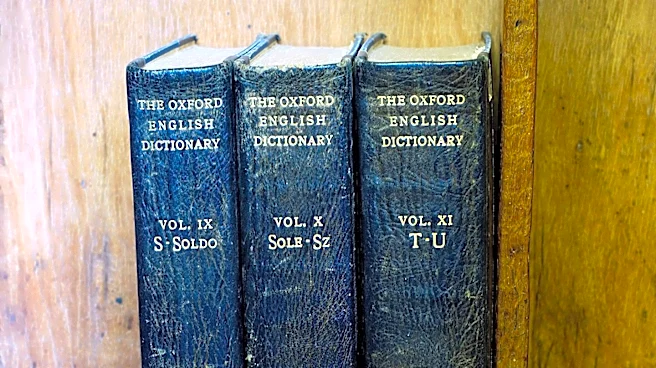
The Oxford English Dictionary has officially recognized over a dozen words long used in Bermuda and across the Caribbean. This inclusion highlights the rich linguistic heritage of these regions. Among the new entries is 'bimpert,' a Bermudian term of unknown
origin describing a foolish person, often used in the phrase 'A bimpert is justah wuffless bye.' Another addition is 'hornerman,' used in Trinidad and Tobago since 1975 to denote an unfaithful man. Other terms include 'to get on' (to have an emotional outburst), 'to cut someone’s tail' (to beat someone), and 'vex money' (money kept by a woman for emergencies). Supernatural entries like 'jablesse,' a malevolent shape-shifting female spirit, and 'douen,' the spirit of an unbaptized child, also made the list. Food-related words such as 'shadeesh' (Bermudian for chorizo), 'sugar cake,' and 'peanut punch' were included, alongside terms like 'nana' or 'nani' (Hindi words for maternal grandparents) and 'Trinbagonian' (referring to people from Trinidad and Tobago). The dictionary also added 'canboulay,' referencing Carnival festivities in Trinidad that celebrated the emancipation of slaves.
Why It's Important?
The official recognition of these words by the Oxford English Dictionary is significant for several reasons. It validates the unique cultural and linguistic identities of Bermuda and the Caribbean, acknowledging their contributions to the English language. For residents like Leonard Alexander from Trinidad, it affirms their heritage, stating, 'That’s our heritage, that’s what we grew up with.' This inclusion helps preserve traditional terms for younger generations, as noted by Avionne George, a maintenance technician in Trinidad, who believes it educates those unfamiliar with older terms like 'douen' and 'la jablesse.' Furthermore, it allows people worldwide to better understand the origins and nuances of Caribbean and Bermudian English, fostering greater cultural appreciation. Sherwin Williams, a construction worker in Trinidad, emphasized that 'People recognize us by our slang,' highlighting the role of language in cultural identity. This move by the Oxford English Dictionary underscores the dynamic and evolving nature of language, reflecting the diverse influences that shape it globally.
What's Next?
The inclusion of these words in the Oxford English Dictionary is likely to spark increased interest in Caribbean and Bermudian dialects and cultures. Educators and linguists may incorporate these newly recognized terms into their studies, potentially leading to a deeper academic exploration of regional English variations. For the communities themselves, this official acknowledgment could foster a renewed sense of pride in their linguistic heritage, encouraging the continued use and preservation of these unique expressions. It might also inspire other dictionaries and linguistic institutions to consider similar inclusions, further broadening the representation of diverse English dialects. The recognition could also lead to more cultural exchanges and tourism, as people become more aware of the rich traditions and language of these islands. This development sets a precedent for recognizing the contributions of other regional dialects to the global English lexicon, potentially paving the way for future inclusions from various communities worldwide.
Beyond the Headlines
Beyond the immediate recognition, this development highlights the broader implications of language as a living, evolving entity deeply intertwined with cultural identity and history. The inclusion of words like 'canboulay,' which stems from acts of defiance and rebellion during the emancipation of slaves, underscores how language can carry historical narratives and collective memory. It challenges the notion of a singular, standardized English, instead celebrating its pluralistic nature and the contributions of diverse communities. This move by the Oxford English Dictionary can be seen as a step towards decolonizing language, acknowledging that linguistic authority does not solely reside in traditional centers but is distributed across various cultural landscapes. It also raises questions about the criteria for linguistic inclusion and the ongoing process of documenting and validating regional dialects. The recognition of terms like 'vex money' and 'hornerman' offers insights into social dynamics and cultural values within these communities, providing a linguistic window into their unique societal structures and interpersonal relationships.