


What's Happening?
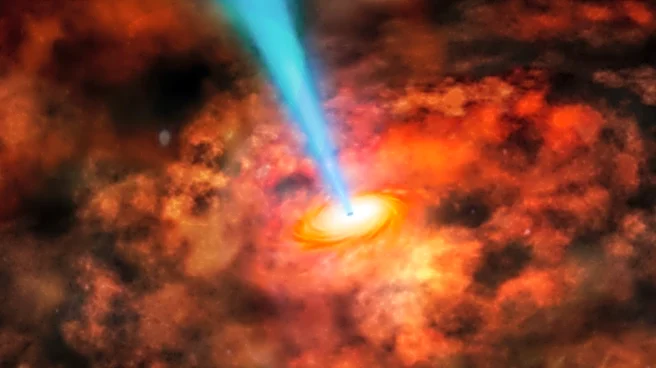
Astronomers have identified two actively feeding supermassive black holes, separated by a mere 175 parsecs (570 light-years), within a galaxy observed when the universe was approximately 2 billion years old. This system, designated MG B2016+112, is located
at a redshift of 3.273 and represents the most compact dual Active Galactic Nuclei (AGN) confirmed to date at such a high redshift. The findings, posted on the arXiv preprint server on September 25, are based on an analysis of archival VLT/MUSE spectra. The study, led by Jianghao Huyan and Júlia M. Sisk-Reynès, utilized gravitational lensing, where a massive foreground galaxy magnifies and bends the light from the distant object, creating multiple images. By examining the spectral information from these lensed images, researchers found strong spectroscopic evidence that two distinct black holes are responsible for the observed emissions. The black hole associated with images A and B has an estimated mass of 20 to 23 million solar masses, while the one linked to image C is estimated at 15 million solar masses, supporting the hypothesis of a major galaxy merger.
Why It's Important?
This discovery offers a rare and crucial glimpse into the growth of black holes during the early stages of the universe, particularly within the context of major galaxy mergers. Models predict that such mergers are significant drivers of gas onto central supermassive black holes, leading to the formation of dual AGNs. However, observing these close pairs has been challenging due to observational limitations. The use of strong gravitational lensing in this study demonstrates a powerful method for overcoming these hurdles, allowing astronomers to reconstruct and study distant objects in detail. Understanding these early universe phenomena is vital for refining our models of galaxy evolution and the co-evolution of galaxies and their central black holes. The similar masses of the two black holes identified further support the idea that merging galaxies each contribute their own black hole, providing empirical evidence for theoretical predictions about galactic formation and interaction.
What's Next?
The research team plans to conduct near-infrared observations to independently verify the masses of the black holes, as the current feeding rate estimates for one of the black holes (C) could be uncertain due to potential inaccuracies in magnification calculations. Further observations will also aim to resolve a puzzling feeding pattern observed, where the lower-mass black hole (C) is feeding more slowly than predicted by simulations. This discrepancy challenges existing models and necessitates additional data to refine our understanding of how black holes accrete matter during mergers. Continued studies of systems like MG B2016+112, utilizing advanced observational techniques and gravitational lensing, will be crucial for building a more comprehensive picture of black hole growth and galaxy evolution in the early universe.
Beyond the Headlines
The identification of such a compact dual AGN system in the early universe has profound implications for our understanding of cosmic structure formation. It suggests that major galaxy mergers, and the subsequent merging of their central supermassive black holes, were more common and occurred earlier than previously thought. This process is believed to be a primary mechanism for the growth of supermassive black holes and the evolution of massive galaxies. The ability to observe these events through gravitational lensing opens new avenues for studying the most extreme environments in the universe, where spacetime is significantly warped. This research not only advances astrophysics but also pushes the boundaries of observational astronomy, demonstrating the power of combining advanced telescopes with natural cosmic phenomena to unveil the universe's deepest secrets.