




What's Happening?
Astronomers using the Atacama Large Millimeter/submillimeter Array (ALMA) have discovered a massive gas streamer, one trillion miles long, feeding the young triple-star system GW Orionis. This system, located 1,300 light-years away in the Orion constellation,
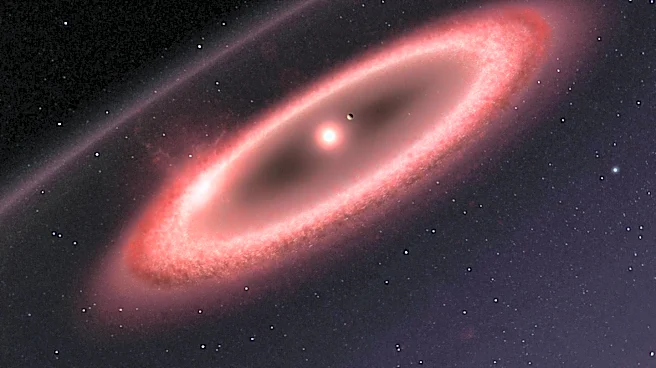
features three stars surrounded by multiple rings of planet-forming material. The rings are tilted at different angles, and the newly observed gas streamer is believed to influence the outer ring's tilted state. The research, led by Maria Galloway-Sprietsma, suggests that the streamer's trajectory aligns with the outer dust ring, indicating a cause-and-effect relationship between the infalling material and the ring's misalignment.
Why It's Important?
This discovery provides new insights into the dynamic processes involved in the formation of planetary systems. The presence of such a massive gas streamer challenges traditional models of planet formation, which typically depict orderly, flat disks of gas and dust. Instead, the findings suggest that turbulent streamers can reshape disks and potentially influence the orbits of forming planets. This has implications for understanding the architecture of exoplanetary systems and the factors that contribute to their diversity. The study also highlights the capabilities of ALMA in observing and analyzing complex astronomical phenomena.
What's Next?
Future research will aim to survey more young systems with similar streamers to determine the prevalence of this mechanism in planet formation. Additional ALMA observations of GW Orionis will focus on identifying shock-tracing molecules to pinpoint where the streamer impacts the disk. This will help astronomers understand how such interactions alter the material available for planet formation and potentially lead to unusual planetary orbits.