







What's Happening?
Gastroenterologists Dr. Rudolph Bedford and Dr. Priya Simoes have weighed in on AI platform Claude's advice regarding gut health, particularly its top recommendation: eating a wide variety of plant fiber, aiming for 30+ different plant foods per week.
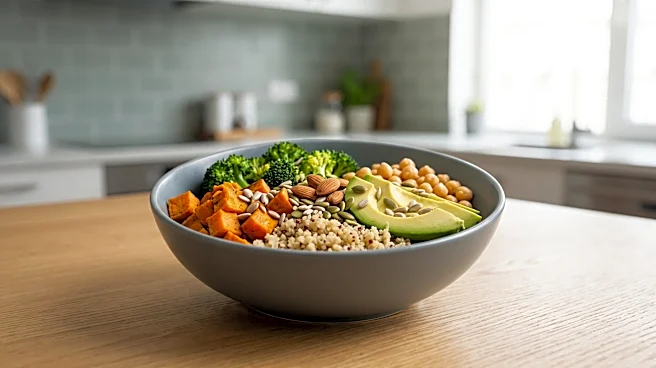
While acknowledging that Claude's advice is 'mostly correct' and that increasing fiber from plants is generally beneficial, both doctors express reservations about the '30+ different plant foods' target. They deem this goal as potentially overwhelming, expensive, and difficult for most people to achieve, suggesting it's an 'overkill.' Instead, they advocate for a more practical approach: a mix of nuts, grains, plants, and seeds, emphasizing that the ideal number of plant sources is individualized. They also stress the importance of avoiding ultra-processed foods and undergoing recommended colorectal cancer screenings.
Why It's Important?
This discussion highlights a critical intersection between emerging AI-driven health advice and established medical expertise in the U.S. While AI can aggregate vast amounts of information, human medical professionals provide crucial context, practicality, and individualized considerations. For consumers, this underscores the importance of consulting healthcare providers for personalized health advice, rather than relying solely on AI. For the food industry, the consensus on increasing plant fiber and reducing ultra-processed foods reinforces existing trends towards healthier, whole-food options. The gastroenterologists' nuanced perspective helps to set realistic expectations for dietary changes, making gut health improvements more accessible and sustainable for the general public, rather than intimidating them with overly ambitious targets.
What's Next?
The ongoing dialogue between AI-generated health recommendations and medical professionals will likely continue to evolve. We can expect AI platforms to refine their advice based on expert feedback, incorporating more practical and individualized guidance. Healthcare providers may increasingly find themselves addressing AI-generated health information with their patients, necessitating clear communication and education. Public health campaigns will likely continue to promote increased fiber intake and reduced consumption of ultra-processed foods, aligning with both AI and expert recommendations. Further research may also explore the optimal diversity of plant foods for gut health, potentially leading to more evidence-based, yet practical, dietary guidelines.
Beyond the Headlines
This scenario touches upon broader ethical and societal implications regarding the role of artificial intelligence in personal health management. While AI offers unprecedented access to information, the challenge lies in ensuring that this information is not only accurate but also actionable, empathetic, and tailored to individual circumstances. The potential for AI to generate 'overkill' advice highlights the need for human oversight and critical evaluation in health recommendations. Culturally, it reflects a growing reliance on technology for health insights, but also a persistent need for human connection and professional guidance in navigating complex health decisions. The long-term impact could be a hybrid model of healthcare, where AI assists in information gathering and preliminary recommendations, while human experts provide personalized care and contextual understanding.