
What's Happening?
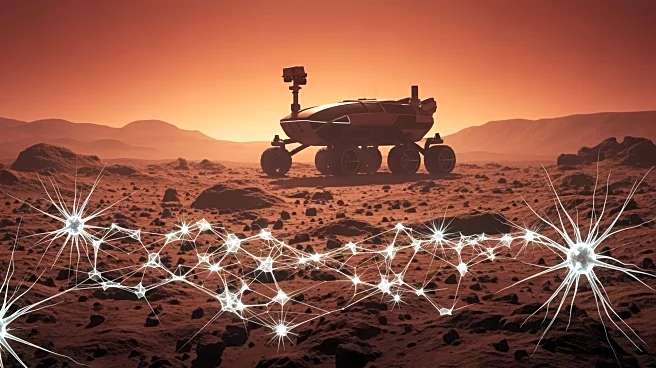
NASA's Perseverance rover, currently exploring the Jezero Crater on Mars, has successfully utilized generative artificial intelligence to autonomously plan its driving route. This development was demonstrated
during a drive on December 10, 2025, marking the 1,709th Martian day of the mission. The AI system analyzed high-resolution images from the HiRISE camera aboard the Mars Reconnaissance Orbiter and terrain-slope data to identify critical terrain features such as bedrock and hazardous boulder fields. This analysis allowed the AI to generate a continuous path with waypoints, enabling the rover to navigate the Martian surface more efficiently. The Jet Propulsion Laboratory, managed by Caltech, is responsible for the operations of the Perseverance rover.
Why It's Important?
The use of AI in planning the rover's path represents a significant advancement in autonomous space exploration. By enabling the rover to make real-time decisions based on terrain analysis, NASA can enhance the efficiency and safety of its missions. This technology reduces the need for constant human intervention, allowing the rover to cover more ground and gather more data. The success of this AI-driven approach could pave the way for future missions, potentially reducing costs and increasing the scope of exploration. This development is crucial for the continued exploration of Mars and other celestial bodies, as it allows for more adaptive and responsive mission planning.
What's Next?
As NASA continues to refine the AI technology used in the Perseverance rover, future missions may see even greater autonomy and efficiency. The lessons learned from this mission will likely inform the design and operation of upcoming Mars missions, including those involving human exploration. The integration of AI in space exploration could also lead to advancements in other areas, such as satellite operations and deep space missions. Stakeholders in the space industry will be closely monitoring these developments, as they have the potential to revolutionize how space exploration is conducted.