





What's Happening?
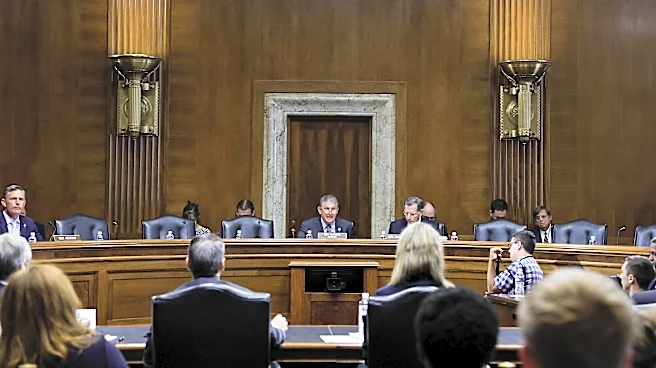
The Senate Appropriations Committee has disclosed a new designation for an air-dropped nuclear gravity bomb, the B94, marking the first entirely new designation of its kind in decades. This information appeared in an explanatory statement accompanying
a draft bill for Fiscal Year 2027 funding for the Department of Energy. The document allocates $77.108 million for the B94, with no prior funding in 2026, and provides no narrative text or further details about the weapon. The last new nuclear bomb designation, the B90, was canceled in 1991. While unconfirmed, it is speculated that the B94 could be related to the Nuclear Deterrent System-Air-delivered (NDS-A), a program aimed at defeating hard and deeply buried targets, which has been in development since at least 2022. The National Nuclear Security Administration (NNSA) has stated that the NDS-A program is moving aggressively to provide the President with additional nuclear options.
Why It's Important?
The emergence of the B94 designation signifies a potential new direction in U.S. nuclear weapons development and modernization efforts. The allocation of significant funding without public explanation raises questions about transparency and the specific capabilities being pursued. If the B94 is indeed the NDS-A, it indicates a strategic focus on neutralizing hardened and deeply buried targets, which could include facilities in countries like Russia, China, North Korea, and Iran. This development could alter the strategic balance by enhancing the U.S.'s ability to hold such targets at risk, potentially influencing deterrence strategies and international relations. The lack of detailed public information, however, could also fuel speculation and concerns among international observers regarding the U.S.'s nuclear posture and its implications for global stability.
What's Next?
The Senate Appropriations Committee's recommendation is not a final appropriation, meaning the draft bill must still pass the Senate, be reconciled with the House, and be signed into law. Further details about the B94 are expected to emerge as the program progresses, though the NNSA has indicated that information will be made public when strategically beneficial. The U.S. government's ongoing push to modernize its entire nuclear triad, including new warheads, delivery systems, and command and control capabilities, suggests that the B94 is part of a broader, long-term strategic initiative. The development of the B61-13, a new, higher-yield version of the B61, and other programs like the W93 warhead, B-21 Raider bomber, and Columbia-class submarines, all point to a comprehensive overhaul of the U.S. nuclear arsenal.
Beyond the Headlines
The introduction of a new nuclear bomb designation like the B94, particularly one potentially designed for 'bunker-busting' capabilities, carries significant ethical and strategic implications. The focus on deeply buried targets suggests a shift in military planning, potentially increasing the perceived utility of nuclear weapons in certain scenarios. This could reignite debates about the role of nuclear weapons in modern warfare and the concept of deterrence. The historical context of canceled programs like the B90 and Robust Nuclear Earth Penetrator highlights the evolving nature of nuclear strategy and the challenges of maintaining a credible deterrent. The secrecy surrounding the B94's specifics also raises questions about the balance between national security and public transparency in nuclear weapons development, potentially impacting arms control discussions and non-proliferation efforts.