



What's Happening?
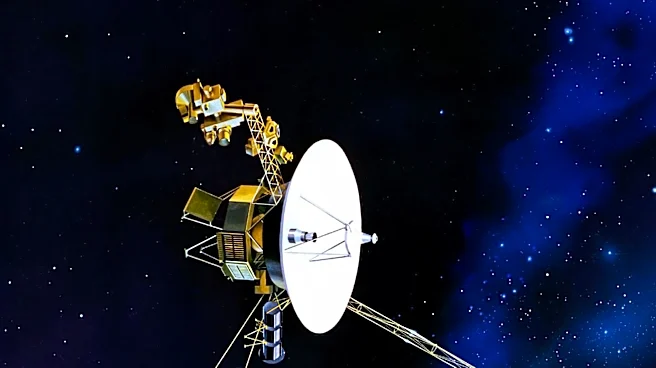
NASA's Voyager 1 spacecraft has successfully crossed the 'one light-day' mark, a significant milestone in its journey through interstellar space. This achievement follows a critical 'Big Bang' fix that resuscitated the spacecraft after a brief loss of
communication on October 20th, which lasted 48 hours. The fix involved alternating three primary units (two heaters and an 8-track digital tape recorder) with three low-power secondary options. This method was previously used to keep Voyager 2 functioning in August. Launched on September 5, 1977, Voyager 1, along with Voyager 2, continues to provide scientific data from beyond the heliosphere, making them the first missions to directly sample this region. The spacecraft relies on Plutonium-fueled radioisotope thermoelectric generators for power, which are steadily losing power at a rate of about 4 watts per year. This power degradation has necessitated difficult decisions, such as turning off the Low Energy Charged Particle experiment (LECP) in early 2026. Currently, the Plasma Wave Subsystem (PWS) and a magnetometer instrument on Voyager 1 remain active.
Why It's Important?
The continued operation and milestones achieved by Voyager 1 are profoundly important for U.S. space exploration and scientific understanding. As the first human-made artifact to reach the 'one light-day' mark, Voyager 1 is pushing the boundaries of interstellar space, providing unprecedented data about the region beyond our solar system. This mission exemplifies American ingenuity and perseverance in scientific endeavors, showcasing the ability of NASA engineers to maintain and adapt complex technology over decades in extreme conditions. The data collected by Voyager 1 offers unique insights into the heliosphere and interstellar medium, contributing to fundamental knowledge about the universe. The challenges of power degradation and the innovative solutions, like the 'Big Bang' fix, highlight the critical engineering expertise required for long-duration space missions. The success of Voyager 1 reinforces the U.S.'s leadership in deep space exploration and inspires future generations in STEM fields, demonstrating the long-term value of sustained investment in scientific research and development.
What's Next?
NASA's Deep Space Network will continue to monitor the increasingly faint signals from Voyager 1, and mission controllers anticipate more signal outages in the coming years due to the spacecraft's immense distance and diminishing power. Despite these challenges, the team hopes the mission will surpass its half-century birthday in space, which is approaching next year. The 'Big Bang' fix has extended the operational life of critical instruments, but future power management decisions will likely be necessary as the spacecraft continues to age. While no immediate successor is planned to escape the solar system soon, the proposed Interstellar Probe mission could one day follow in Voyager's footsteps. The ongoing data transmission from Voyager 1 will continue to provide valuable information about interstellar space, influencing future mission designs and scientific objectives for exploring the outer reaches of our solar system and beyond.
Beyond the Headlines
The Voyager 1 mission transcends its scientific achievements, embodying a profound cultural and philosophical significance. Its journey into interstellar space represents humanity's innate drive to explore the unknown and our capacity for long-term vision and dedication. The iconic images and data sent back by Voyager have reshaped our understanding of the solar system and our place within the cosmos. The spacecraft also carries the 'Golden Record,' a time capsule intended to convey the story of Earth to any intelligent extraterrestrial life it might encounter, serving as a testament to human civilization. The mission's longevity, far exceeding its initial design life, raises ethical considerations about the preservation of historical space artifacts and the enduring legacy of human exploration. Voyager 1's continued operation, despite its age and distance, symbolizes humanity's persistent quest for knowledge and connection across vast cosmic distances, inspiring awe and wonder about the universe.