
What's Happening?
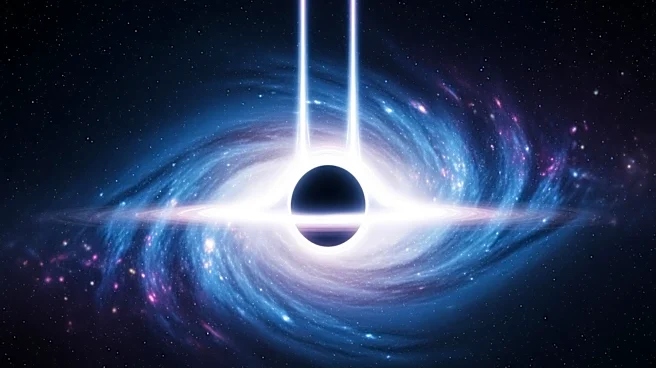
Astronomers have successfully measured the power of jets emitted from the Cygnus X-1 black hole system, revealing an output equivalent to nearly 10,000 suns. This binary system, located about 7,200 light-years
from Earth, consists of a black hole and a blue supergiant star. The black hole draws material from its companion star, creating conditions for launching powerful jets into space. The research, led by Steve Prabu of the University of Oxford, utilized 18 years of high-resolution radio observations. The jets were observed traveling at approximately half the speed of light, marking a significant achievement in capturing real-time jet activity. The study, published in Nature Astronomy, highlights the interaction between the jets and the stellar wind from the supergiant star, causing the jets to bend and displace. This research provides new insights into the role of black hole jets in shaping cosmic structures.
Why It's Important?
The findings from this study are crucial for understanding the broader impact of black hole jets on the universe. These jets can generate shocks and turbulence, influencing surrounding gas and cosmic structures over large distances. The ability to measure jet power directly, rather than relying on historical averages, represents a major technical advancement for astronomers. This research could improve models of large-scale structure formation in the universe, which currently struggle to reproduce observed galaxy properties without accounting for the energy injected by black hole jets. The study also opens up possibilities for applying similar techniques to other black hole systems, potentially enhancing our understanding of how these cosmic phenomena interact with their environments.