






What's Happening?
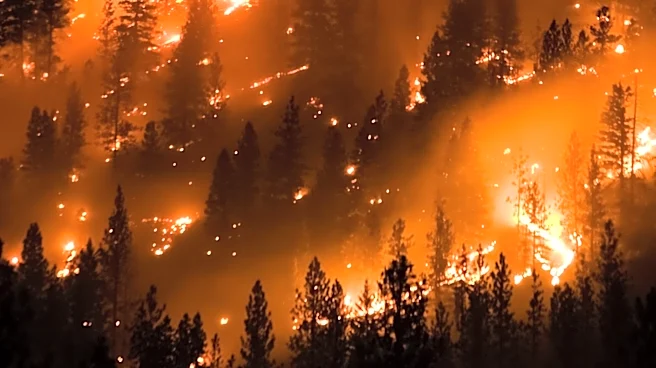
California is facing a complex and interconnected crisis involving its electricity rates and wildfire insurance market, largely driven by a unique legal doctrine known as 'inverse condemnation with strict liability.' This doctrine, applied to utilities
since 1999, holds them entirely responsible for damages caused by wildfires ignited by their equipment, even if the utility was not negligent. This has led to utilities investing heavily in mitigation and passing these costs, along with insurance payouts, directly to ratepayers, resulting in the highest electricity rates in the continental U.S. Concurrently, the state's home insurance market is in disarray, with many private insurers withdrawing due to wildfire risks and price controls. This forces a growing number of homeowners onto the state's 'FAIR Plan,' an insurer of last resort, which is subsidized by other insured residents. The situation has been exacerbated by the 2018 Camp Fire, which led to PG&E's bankruptcy and the creation of a state Wildfire Fund, further entrenching the current system where ratepayers bear significant financial burdens.
Why It's Important?
This situation has profound implications for California's economy, residents, and climate goals. The exorbitant electricity rates disproportionately affect lower-income households, particularly those in the Central Valley who rely on air conditioning and may not have rooftop solar. These high costs also hinder the state's ambitious electrification efforts, making it less economically viable for residents to switch to electric vehicles and appliances, thereby slowing decarbonization. The breakdown of the insurance market threatens the stability of the housing market, as mortgages often depend on annual insurance renewals, potentially leaving many homeowners with uninsurable assets. The current system also disincentivizes homeowners and local governments from investing in wildfire mitigation, as they anticipate being bailed out by utilities. This creates a cycle where risk is continually shifted to utilities and, ultimately, to ratepayers, rather than being addressed at its source, leading to inefficient and expensive wildfire risk reduction strategies.
What's Next?
Governor Newsom is reportedly proposing legislative changes to address these intertwined issues. Potential reforms include shifting from a strict liability standard to a fault-based standard for utilities, meaning they would only be liable if negligent. This would necessitate concurrent reforms in the insurance market, such as allowing insurers to use forward-looking risk models and pass on reinsurance costs, which California has recently begun to implement. To mitigate the impact on homeowners, especially those in high-risk areas who might face unaffordable premiums, proposals suggest sunsetting the FAIR Plan while providing grants or second mortgages for home hardening. This approach aims to redistribute risk from the rate base (electricity bills) to the tax base, making the system more progressive. However, such reforms face significant political challenges from various stakeholders, including homeowners, local governments, and consumer advocacy groups, who benefit from the current system's subsidies and protections.
Beyond the Headlines
The California wildfire and insurance crisis highlights deeper systemic issues within the state's governance and economic structure. The reliance on ballot propositions, while intended to empower voters, has sometimes led to enshrined laws like Prop 103 that create unintended consequences and make it difficult to adapt to changing realities. The unique regulatory environment for utilities, which are captive entities unable to leave the state, allows for costs to be easily placed upon them, which are then passed to consumers. This creates a 'scapegoat' dynamic where utilities absorb risk, but the ultimate financial burden falls on the public through regressive electricity rates. The situation also underscores the challenge of balancing public safety, economic affordability, and environmental goals in a state highly vulnerable to climate change impacts. The long-term implications could include continued outward migration from high-risk areas, increased social inequality due to regressive cost burdens, and a slower transition to a green economy if energy remains prohibitively expensive.