







What's Happening?
Aalto University in Finland is conducting research into advanced cooling technologies for integrated devices, specifically focusing on solid-state optical cooling and efficient microwave-to-optical conversion. This research involves the development of
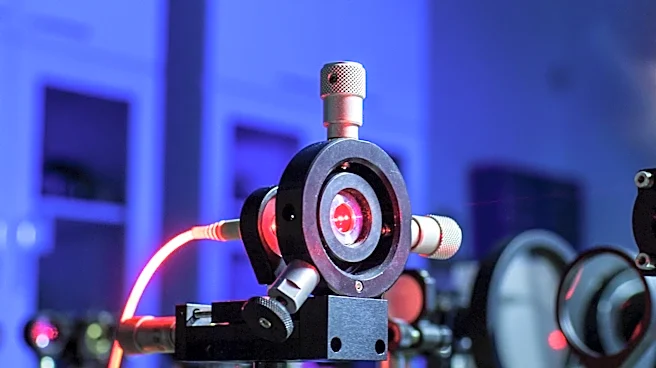
high-Q optical cavities and suitable fiber-to-chip coupling schemes for operation at millikelvin temperatures. The university is seeking doctoral and postdoctoral researchers with expertise in III-V semiconductor device fabrication, epitaxy, optical packaging, and the optics and physics of compound semiconductors. The goal is to demonstrate breakthroughs in solid-state optical cooling and to achieve efficient microwave-to-optical conversion within integrated devices, which could have implications for quantum computing and advanced chip technologies. The work also involves coupling superconducting qubits, magnons, and photoluminescent spin ions within single chip-scale devices.
Why It's Important?
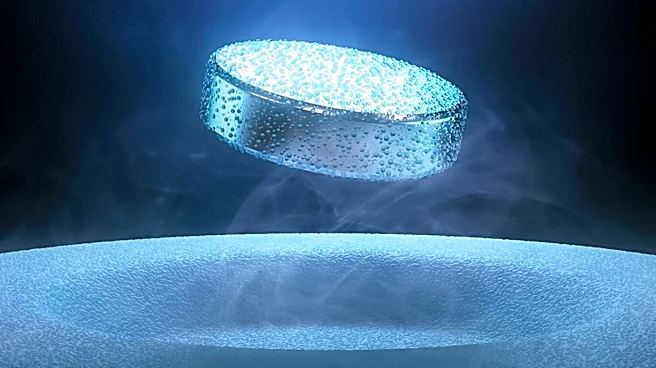
This research is crucial for the future of high-performance computing and quantum technologies. As chips become more powerful and integrated, thermal management becomes a significant challenge. Traditional cooling methods may not be sufficient for the extreme conditions required by advanced quantum devices. Solid-state optical cooling offers a potential solution to dissipate heat more efficiently at very low temperatures, which is essential for maintaining the coherence and functionality of quantum systems. Furthermore, efficient microwave-to-optical conversion is vital for quantum transduction, enabling the transfer of quantum information between different physical systems, such as superconducting qubits (microwave domain) and optical fibers (optical domain). This capability is fundamental for building scalable quantum networks and distributed quantum computing architectures, impacting U.S. efforts in these strategic technological areas.
What's Next?
The ongoing research at Aalto University aims to demonstrate the practical application of these cooling and conversion technologies. Future steps include the structuring of integrated high-Q optical cavities and the development of fiber-to-chip coupling schemes optimized for millikelvin operation. The devices will then be packaged to combine optical and microwave access with the necessary thermal anchoring and low heat load. The ultimate goal is to achieve efficient microwave-to-optical conversion in these integrated devices. Success in these areas could lead to new designs for quantum computers and advanced sensors, potentially attracting further international collaboration and investment, including from U.S. technology firms and research institutions seeking to leverage these advancements for their own development roadmaps.
Beyond the Headlines
The implications of this research extend beyond immediate technological advancements. The ability to precisely control and cool integrated devices at quantum scales could unlock entirely new paradigms in computing and information processing. It addresses fundamental physical limitations that currently hinder the scaling of quantum systems. Ethically, the development of more powerful and efficient quantum technologies raises questions about data security and the potential for new forms of encryption or decryption. Culturally, breakthroughs in quantum computing could reshape scientific understanding and lead to unforeseen applications, similar to the impact of classical computing. The long-term shift could be towards a new era of quantum-enabled technologies that fundamentally alter industries from healthcare to finance and defense, with significant geopolitical and economic ramifications.