






What's Happening?
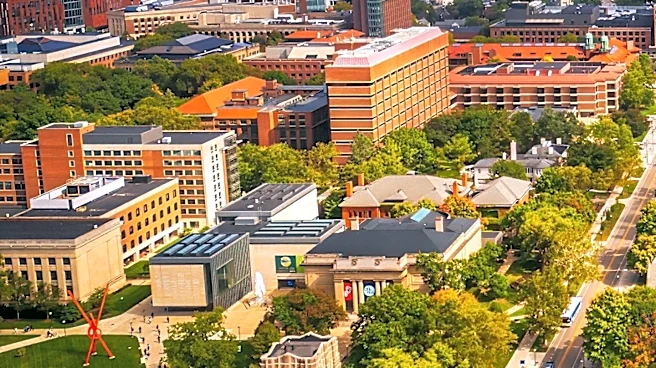
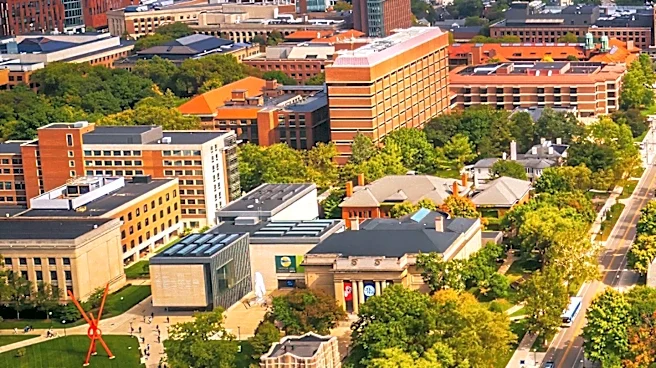
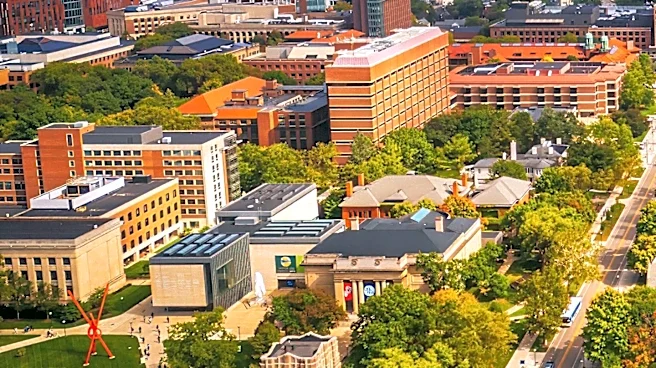
The University of Michigan has emerged victorious in the 'Piss Off' competition against Michigan State, collecting 137 gallons of urine compared to Michigan State's 100 gallons. This event, held at Ann Arbor's Big House on November 7, was not merely a rivalry
contest but a significant initiative for wastewater research. Scientists from both universities aimed to collect donated urine to convert it into nutrient-rich fertilizer, a process known as 'peecycling.' Stephen Gasteyer, an Associate Professor of Sociology at Michigan State, explained that the event served a dual purpose: gathering raw material for the project and educating the public on the potential of urine as a sustainable resource. The current methods of treating urine are energy-intensive and dispose of valuable nutrients that could otherwise benefit agriculture. While the United States currently restricts the use of urine on food crops, it can be applied to other crops like grass and flowers.
Why It's Important?
This 'Piss Off' competition is important because it highlights an innovative approach to sustainable resource management and waste reduction, particularly in the context of agriculture. The 'peecycling' initiative, converting urine into fertilizer, addresses critical environmental concerns related to wastewater treatment and nutrient recovery. Current wastewater treatment processes are energy-intensive and often discard valuable nutrients, contributing to environmental pollution. By demonstrating the feasibility and benefits of urine-derived fertilizer, the project could pave the way for more sustainable agricultural practices, reducing reliance on synthetic fertilizers and mitigating their environmental impact. Although U.S. regulations currently limit its use on food crops, the success of this research could influence future policy changes, fostering a more circular economy where waste products are repurposed for beneficial uses. This initiative also serves as a public awareness campaign, educating individuals about their role in sustainable practices and the potential value of what is typically considered waste.
What's Next?
The collected urine from the 'Piss Off' competition will be used by wastewater research scientists from both the University of Michigan and Michigan State to optimize the 'peecycling' process and make the fertilizer available for use. Dr. Nancy Love, a civil and environmental engineer at the University of Michigan, whose lab houses the nation's first university-based end-to-end peecycling demo system, will utilize this raw material. The project, partly funded by a University Research Council Grant, aims to produce fertilizer that will be applied to agricultural fields at both universities, including Michigan State's Kellogg Biological Center and the University of Michigan's Matthaei Botanical Gardens. Future developments may include the market release of a new toilet designed to separate urine for collection, further research into regulatory changes for food crop application, and broader adoption of peecycling technologies.
Beyond the Headlines
Beyond the immediate scientific and environmental implications, the 'Piss Off' competition and the 'peecycling' initiative delve into deeper societal perceptions of waste and resource utilization. The playful yet provocative name of the competition serves to break down taboos surrounding human waste, encouraging a more open dialogue about its potential as a valuable resource. This project challenges conventional notions of sanitation and highlights the untapped potential in what is typically flushed away. Ethically, it prompts a re-evaluation of our relationship with natural cycles and the imperative to close nutrient loops for a more sustainable future. Culturally, it could contribute to a shift in public consciousness, fostering greater acceptance of innovative, albeit unconventional, solutions to environmental challenges. The success of such initiatives could inspire similar projects globally, pushing the boundaries of what is considered waste and what can be repurposed for ecological benefit.