




What's Happening?
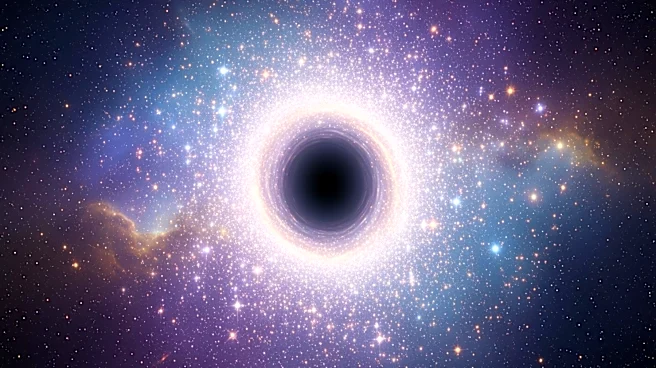
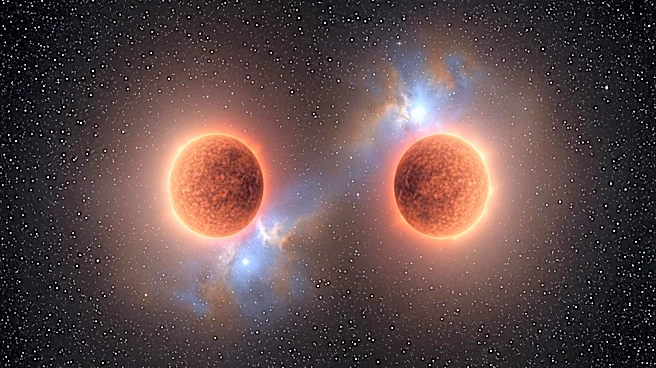
Recent research has uncovered that the largest black holes in the universe may form through the merger of smaller black holes within dense star clusters, rather than from the collapse of massive stars. This study, conducted by a team including Isobel
Romero-Shaw and Fabio Antonini from Cardiff University, analyzed gravitational waves detected by observatories such as LIGO, KAGRA, and Virgo. The findings suggest a 'mass gap' where stars above 45 solar masses do not form black holes but instead undergo supernovae. The research indicates that high-mass black holes, which exhibit rapid spins, are likely the result of repeated mergers in these dense environments, challenging previous models of stellar evolution.
Why It's Important?
This discovery has significant implications for our understanding of stellar evolution and the lifecycle of stars. By identifying a distinct population of high-mass black holes formed through mergers, the study challenges existing models and suggests that dense star clusters play a crucial role in the formation of these cosmic giants. This could lead to a reevaluation of how black holes grow and evolve, impacting theories about the dynamics of star clusters and the end stages of massive stars. The findings also enhance the role of gravitational-wave astronomy in uncovering the mysteries of the universe, providing new insights into the processes that govern the formation of black holes.