
What's Happening?
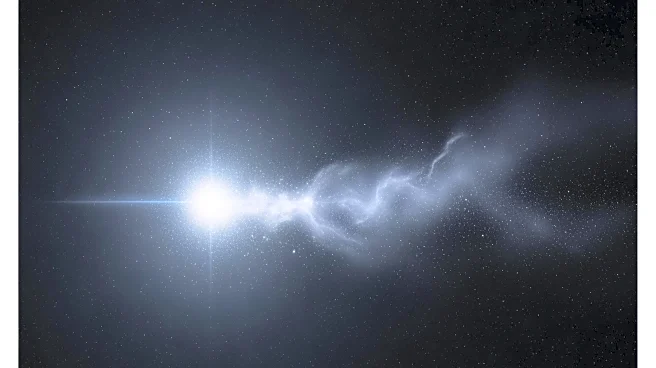
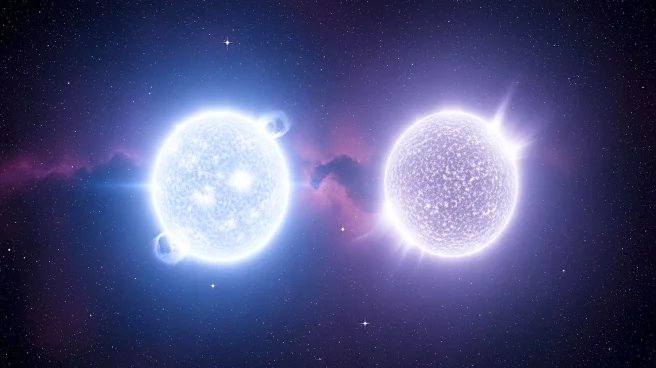
A groundbreaking discovery has been made with the detection of a 10-second gamma-ray burst, designated GRB 250314A, originating from a supernova that exploded 13 billion years ago. This event, detected by the SVOM satellite and confirmed by the James
Webb Space Telescope (JWST), is the most distant supernova ever observed. The burst, which occurred when the universe was only 730 million years old, provides new insights into the early universe's star formation and evolution. The detection was a coordinated effort involving multiple international observatories, including NASA's Neil Gehrels Swift Observatory and the European Southern Observatory. The gamma-ray burst's characteristics suggest it was a standard Type II supernova, similar to those observed in the modern universe, challenging previous assumptions about early star deaths.
Why It's Important?
This discovery is significant as it reshapes our understanding of the early universe's star formation and evolution. The ability to observe such distant cosmic events allows scientists to study the conditions and processes that occurred shortly after the Big Bang. The findings suggest that galaxies and stars may have evolved faster than previously thought, with chemical enrichment processes already underway just 730 million years after the Big Bang. This challenges the notion that early stars, known as Population III stars, died in highly energetic and asymmetric explosions. Instead, the data indicates that early supernovae were similar to those seen today, suggesting a more rapid evolution of galaxies and star formation.
What's Next?
Researchers plan to continue monitoring similar high-redshift events using the JWST and other observatories. These future observations will focus on detecting afterglows and host galaxies to build a clearer picture of early stellar evolution. The ongoing study of gamma-ray bursts will help refine models of the early universe and improve our understanding of cosmic evolution. The findings could lead to a reevaluation of the timeline and processes involved in the formation of the first stars and galaxies, providing a more comprehensive view of the universe's history.
Beyond the Headlines
The detection of GRB 250314A highlights the potential of gamma-ray bursts as tools for probing the universe's earliest epochs. Their brightness and distinct signatures offer a complementary approach to traditional deep-field imaging, allowing scientists to trace cosmic events from billions of years ago. This discovery also underscores the importance of international collaboration in advancing our understanding of the cosmos. The ability to observe and analyze such distant events is a testament to the advancements in astronomical technology and the power of coordinated global research efforts.