







What's Happening?
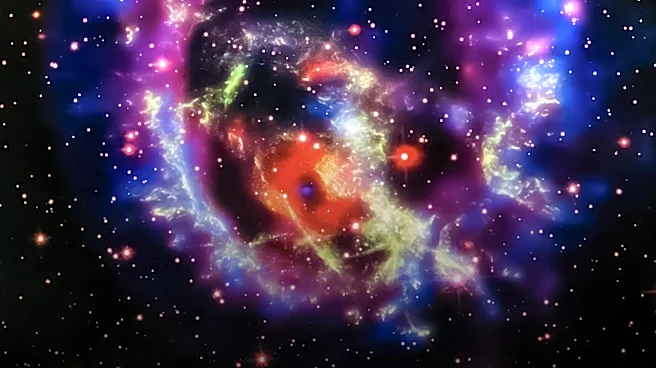
In 1572, Danish astronomer Tycho Brahe observed a supernova, a stellar explosion, which appeared as a new star in the night sky. This event, occurring before the invention of the telescope, challenged the prevailing belief that the heavens were unchanging.
Brahe's meticulous observations demonstrated that the celestial sphere was dynamic, leading to significant advancements in astronomy. His work laid the groundwork for future astronomers like Johannes Kepler, who further developed the heliocentric model of the solar system. The supernova observed by Brahe was a Type Ia supernova, involving a white dwarf star accumulating material from a companion star until it exploded.
Why It's Important?
Tycho Brahe's observation of the supernova was pivotal in shifting the scientific perspective from an Earth-centered to a Sun-centered universe. This change was crucial in the development of modern astronomy, as it provided evidence that contradicted the long-held belief in the immutability of the stars. Brahe's work inspired the construction of more advanced observatories and influenced Kepler's laws of planetary motion, which are fundamental to our understanding of the solar system. The event marked a significant departure from mystical interpretations of celestial phenomena, steering science towards empirical observation and measurement.