







What's Happening?
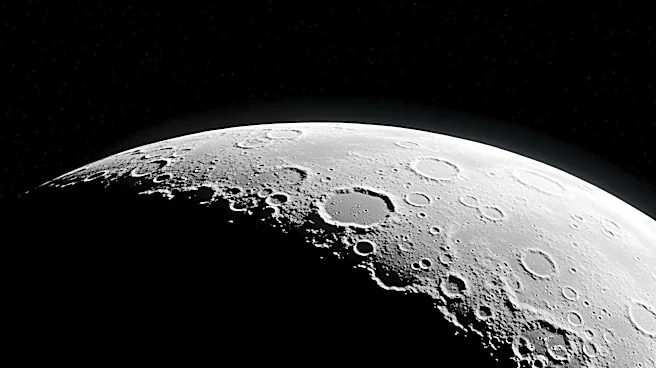
NASA has released more than 12,000 images from the Artemis 2 mission, which marked a significant step in human space exploration by sending astronauts close to the moon for the first time since 1972. The mission involved four astronauts aboard the Orion
spacecraft, who captured stunning images of the moon, Earth, and a solar eclipse. These images were taken using various cameras, including Nikon D5s, a Nikon Z9, and GoPros, and were delivered to Earth via physical memory cards after the mission's conclusion. The photos are now available in NASA's Gateway to Astronaut Photography of Earth database, providing researchers and the public with access to these visual records. The images include views of lunar surface targets, ancient impact craters, and the Earth from space, offering insights into the moon's features and the mission's achievements.
Why It's Important?
The release of these images is significant as it provides valuable data for scientific research and public engagement. The photos offer insights into lunar geology and the effects of space travel on human perception of celestial bodies. By making these images publicly accessible, NASA enhances transparency and fosters interest in space exploration. The mission itself is a precursor to future lunar exploration efforts, including the planned Artemis 3 mission, which aims to land astronauts on the moon. The data collected will aid in understanding the moon's evolution and inform future missions, potentially leading to sustainable human presence on the lunar surface. This initiative also strengthens international collaboration in space exploration, as demonstrated by the involvement of a Canadian astronaut in the mission.
What's Next?
Following the successful completion of Artemis 2, NASA is preparing for the next phase of the Artemis program. The upcoming mission, scheduled for 2027, will involve testing the Orion spacecraft's docking capabilities with commercial lunar landers in low-Earth orbit. Astronauts will also evaluate new space suits designed for lunar exploration. These steps are crucial for the eventual goal of establishing a sustainable human presence on the moon. The International Astronomical Union will review proposed names for lunar craters identified during the mission, potentially adding to the scientific and cultural legacy of the Artemis program.