
What's Happening?
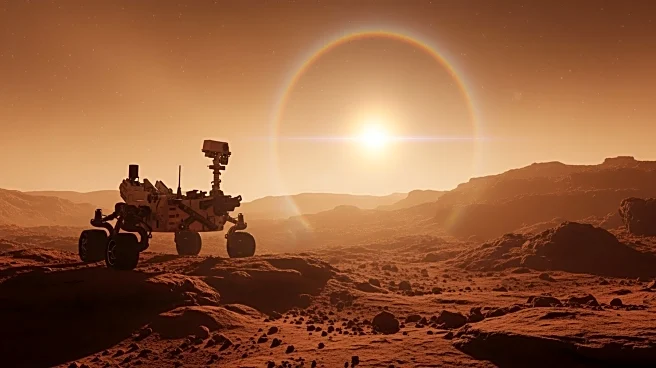
NASA has confirmed the complete loss of communication with the MAVEN spacecraft, which has been orbiting Mars since 2014 to study its atmosphere. The last successful telemetry was received on December 6, 2025. The spacecraft, known as the Mars Atmosphere
and Volatile EvolutioN (MAVEN), was launched on November 18, 2013, and arrived at Mars on September 21, 2014. Its primary mission has been to measure the rate at which oxygen and hydrogen escape from the Martian atmosphere, providing insights into how Mars lost most of its air and water over billions of years. Before the loss of contact, MAVEN entered a planned safe mode. NASA is investigating potential causes, including a software glitch, power system issue, or high-gain antenna failure. Engineers are working to re-establish contact, and a detailed report is expected soon.
Why It's Important?
The loss of contact with MAVEN is significant as it impacts ongoing research into Mars' atmospheric history, which is crucial for understanding the planet's evolution and potential habitability. MAVEN's data has been instrumental in revealing how Mars transitioned from a wet planet to its current dry state. The mission's findings are vital for future Mars exploration missions, including those aimed at searching for signs of past life. The inability to communicate with MAVEN could hinder the continuity of data collection and analysis, affecting scientific understanding and planning for future missions. The situation underscores the challenges of long-term space missions and the importance of robust communication systems.
What's Next?
NASA is expected to release a detailed report on the MAVEN anomaly in the coming days. Engineers are actively attempting to re-establish communication with the spacecraft. If contact cannot be restored, the mission team will focus on analyzing the extensive data already collected over the past 11 years. The scientific community will be closely monitoring the situation, as the outcome could influence future mission designs and strategies for Mars exploration. The incident may also prompt discussions on improving spacecraft communication and fault tolerance in future missions.