
What's Happening?
Democratic U.S. Senator Ben Ray Luján currently holds a significant lead over his Republican challenger, Larry Marker, in New Mexico's U.S. Senate race. A recent Journal Poll, conducted between August
21 and August 28, indicates that Luján has the support of 53% of likely voters, while Marker trails with 38%. The poll surveyed 516 likely New Mexico voters and has a margin of error of plus or minus 4.3 percentage points. Luján, who was first elected to the U.S. Senate in 2020 after serving six terms in the U.S. House of Representatives, is seeking re-election. Pollster Brian Sanderoff of Research & Polling Inc. attributes Luján's early advantage to his statewide name recognition and established political profile. Luján shows strong performance among Democratic, independent, Hispanic, and women voters, with 56% of independent voters supporting him compared to 25% for Marker. Regionally, Luján leads in the Albuquerque metropolitan area and north-central New Mexico, while Marker performs better in the eastern and northwestern parts of the state.
Why It's Important?
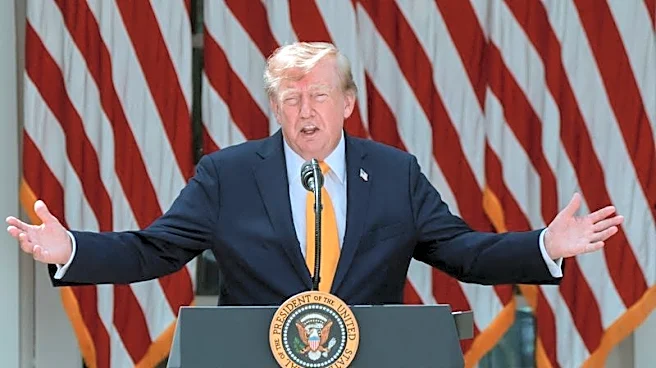
This poll highlights the current political landscape in New Mexico and the potential trajectory of a key U.S. Senate race. A significant lead for an incumbent Democrat like Senator Luján suggests a degree of stability for the Democratic Party in the state, which could influence national Senate control. The poll also underscores the impact of national politics on local races, as President Trump's job approval rating in New Mexico (32% approval, 61% disapproval) appears to correlate with voter preferences in the Senate race. Voters disapproving of President Trump overwhelmingly favor Luján, while those who approve largely support Marker. This dynamic indicates that national sentiment towards the presidential administration can be a powerful factor in down-ballot races, potentially mobilizing different segments of the electorate. The outcome of this race will determine New Mexico's representation in the U.S. Senate and could contribute to the broader balance of power in Congress.
What's Next?
As the election cycle progresses, both Senator Luján and Larry Marker will likely intensify their campaigns to sway undecided voters and solidify their bases. The Pollsmax 2026 New Mexico Senate Forecast projects Luján to win with 55.8% of the vote to Marker’s 44.2%, indicating a projected margin of D +11.5, and rates the race as 'Likely D.' This forecast, updated with 100,000 simulations, suggests a strong likelihood of Luján retaining his seat. Future polling data will be crucial in tracking any shifts in voter sentiment, especially as national political events unfold and campaign efforts ramp up. The candidates will likely focus on key demographics and regions where they can gain an advantage, with Luján aiming to maintain his strong support among independent and Hispanic voters, and Marker seeking to improve his standing in the eastern and northwestern parts of the state. The role of national political figures and their approval ratings will continue to be a significant factor influencing voter behavior.
Beyond the Headlines
The New Mexico Senate race offers insights into the evolving political demographics and voting patterns within the state. The strong support for Senator Luján among independent and Hispanic voters, as well as women, reflects a broader trend in some Western states where these groups are increasingly influential. The correlation between President Trump's approval ratings and voter preference in the Senate race suggests a continued nationalization of local elections, where voters' views on federal leadership can heavily influence their choices for state-level representatives. This dynamic could lead to increased focus on national issues in local campaigns, potentially overshadowing state-specific concerns. The race also highlights the importance of established political profiles and name recognition, as noted by pollster Brian Sanderoff, which can provide a significant advantage to incumbents in competitive races. The outcome will not only determine New Mexico's representation but also serve as a barometer for the effectiveness of different campaign strategies in a politically diverse state.