





What's Happening?
Scientists, led by the University of Southampton in the UK, have found evidence suggesting a colossal 'great escarpment' once stretched thousands of kilometers across ancient North America. This cliff line, estimated to be 1-kilometer-high (0.6-mile-high),
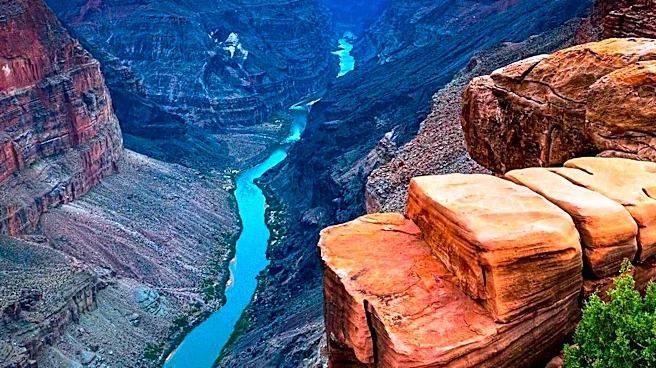
formed approximately 800 million years ago during the breakup of the supercontinent Rodinia. The study, published in Geology, proposes that this vast escarpment drove the erosion of enormous volumes of rock, exposing an ancient crystalline basement now visible in the Grand Canyon in southern Arizona. The research indicates that this ancient escarpment occupied a similar position relative to the continental margin as modern great escarpments in South Africa and Brazil. Over tens of millions of years, as the escarpment slowly retreated inland, it is predicted to have stripped away up to 8 kilometers (5 miles) of rock in certain areas. This finding is consistent with existing evidence of extraordinary erosion in the region, estimated at 5–10 kilometers (3–6 miles) of rock, long before the modern Grand Canyon was carved by the Colorado River.
Why It's Important?
This discovery provides a crucial missing piece in understanding the geological history of the Grand Canyon and the broader southwestern U.S. The Grand Canyon's geological record spans 2 billion years, yet more than half of its rock record appears to be absent, a phenomenon known as the Great Unconformity. The proposed ancient escarpment offers an explanation for this significant gap, suggesting that the Canyon's basement rocks were progressively brought to the surface as part of this immense geological feature. The long-lived tectonic landscape created by the escarpment helps explain the dramatic variations in erosion associated with the Great Unconformity across the region. Furthermore, the study suggests that the tectonic uplift related to continental rifting and breakup created steep slopes and high ground, providing the mountainous terrain that facilitated extensive erosion by rivers and glaciers. This reinterpretation of the Grand Canyon's ancient history could lead to a better understanding of how Earth's continents have changed over hundreds of millions of years, influencing how geologists interpret other ancient continental interiors with similar large gaps in their records.
What's Next?
The findings from this study are expected to prompt further research into the geological processes that shaped ancient North America and other continental interiors. Geologists may now focus on re-examining other regions with significant gaps in their rock records, applying the insights gained from this 'mega-escarpment' hypothesis. The study's implications for understanding the Great Unconformity could lead to new models for continental rifting and erosion. Researchers might also explore how this ancient mountainous rim around western Laurentia—the ancient core of North America—controlled river flows, sediment accumulation, and the timing of rising seas before the Cambrian explosion, a period of rapid diversification of complex life. Comparing the Grand Canyon's ancient history with active landscapes like the Great Escarpment of South Africa will likely continue to provide valuable comparative data for future geological investigations.
Beyond the Headlines
The concept of a 'mega-escarpment' across ancient North America highlights the immense scale and long-term impact of geological forces on Earth's surface. This research not only deepens our understanding of the Grand Canyon's formation but also underscores the dynamic nature of continents over hundreds of millions of years. The Great Unconformity, a mysterious billion-year gap in the rock record, has long puzzled geologists. This study offers a compelling explanation, suggesting that massive erosion driven by the escarpment systematically removed vast quantities of rock. This has broader implications for how we interpret geological timelines and the processes that expose deep crustal rocks. The study also touches upon the interplay between tectonic activity, landscape evolution, and the conditions that set the stage for major biological events like the Cambrian explosion, demonstrating the interconnectedness of Earth's physical and biological history.