





What's Happening?
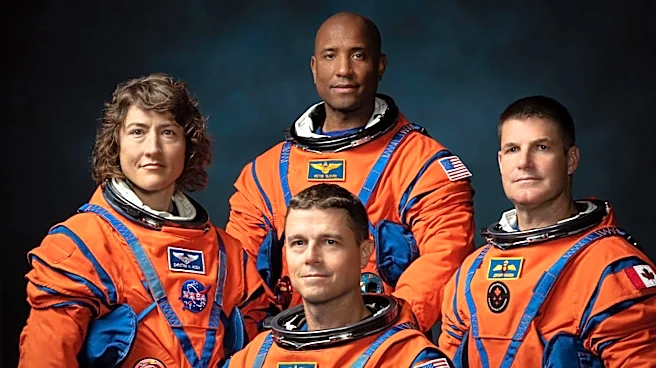
Kelsey Young, the Artemis II lunar science lead at NASA’s Goddard Space Flight Center in Greenbelt, Maryland, has been selected to present the American Geophysical Union’s (AGU) Eugene Shoemaker Lecture for 2026. This annual award recognizes excellence
in planetary exploration. Young's work focuses on integrating science into human spaceflight, drawing inspiration from Eugene Shoemaker's pioneering efforts in this field. She is responsible for developing science questions, tools, instruments, and operational concepts that enable astronauts to explore other planetary bodies. Additionally, Young serves as the Artemis science flight operations lead, having developed the new science console in Mission Control and becoming the first certified science officer. As the Artemis II lunar science lead, she guided the mission's lunar science team in developing lunar science objectives.
Why It's Important?
Kelsey Young's selection for the Eugene Shoemaker Lecture highlights the critical role of scientific leadership in advancing U.S. space exploration, particularly within the Artemis program. Her work directly contributes to the success of human missions to the Moon, ensuring that these endeavors yield significant scientific returns. By focusing on the integration of science into human spaceflight, Young is helping to shape the future of lunar exploration, making sure that astronauts are equipped with the knowledge and tools to conduct meaningful research on other planetary bodies. Her role as the Artemis science flight operations lead and the first certified science officer underscores the evolving nature of space missions, where scientific expertise is increasingly integrated into operational control. This recognition also emphasizes the importance of planetary geology and field work in preparing astronauts for the unique challenges of exploring extraterrestrial environments.
Beyond the Headlines
Kelsey Young's work extends beyond the immediate objectives of the Artemis missions, influencing the broader trajectory of U.S. space exploration. Her efforts in developing operational concepts and scientific protocols for lunar exploration will set precedents for future human missions to Mars and beyond. The emphasis on field geology training for astronauts, which Young conducts in impact-cratered and volcanic terrains, is crucial for developing the practical skills needed for extraterrestrial fieldwork. This approach ensures that astronauts are not just pilots or engineers, but also capable scientists who can make on-the-spot geological observations and decisions. Her leadership in integrating science into Mission Control operations represents a significant step towards a more science-driven approach to human spaceflight, potentially leading to more efficient and scientifically productive missions in the long term. This recognition by the AGU also serves to inspire future generations of scientists and engineers to pursue careers in planetary science and space exploration.