



What's Happening?
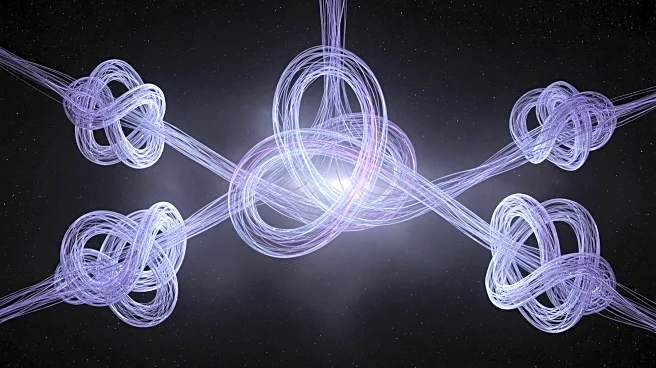
A team of physicists in Japan has proposed a new model suggesting that 'cosmic knots' could explain the universe's matter-antimatter imbalance. These knots, formed in the early universe, may have briefly dominated as a form of energy before collapsing
in a way that favored matter over antimatter. This process could have stirred spacetime, producing gravitational waves detectable by future experiments. The study, published in Physical Review Letters, combines a gauged Baryon Number Minus Lepton Number (B-L) symmetry with the Peccei-Quinn (PQ) symmetry, allowing stable knotted configurations to form and potentially explaining the observed matter surplus.
Why It's Important?
Understanding the matter-antimatter imbalance is crucial as it explains why the universe is composed of matter, allowing for the existence of stars, galaxies, and life. The proposed model offers a new perspective on baryogenesis, a central unsolved problem in physics. If validated, it could reshape our understanding of the early universe and the fundamental forces at play. The model's predictions could be tested by upcoming gravitational-wave observatories, potentially confirming the existence of cosmic knots and their role in the universe's evolution.
What's Next?
The next steps involve refining theoretical models and simulations to predict the formation and decay of these cosmic knots. Future gravitational-wave experiments, such as LISA, Cosmic Explorer, and DECIGO, may test whether the universe experienced a knot-dominated era. If confirmed, this could provide a more complete understanding of the universe's origins and the forces that shaped it.