






What's Happening?
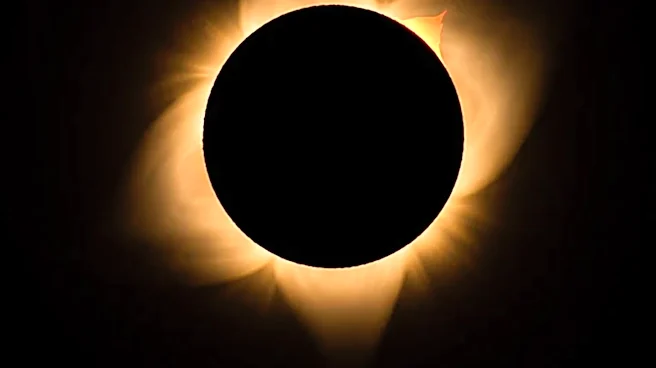
On August 12, 2026, a total solar eclipse will occur, captivating millions as the moon passes between the Earth and the sun. This celestial event will be visible along a path of totality that stretches across Spain, Iceland, and Greenland. Observers within
this path will experience the moon completely obscuring the sun, while those outside will witness a partial eclipse. The eclipse will begin in Alaska at 11:34 a.m. EDT and conclude off the west coast of Africa at 3:57 p.m. EDT. The event will feature several stages, including the diamond ring effect and Baily's Beads, offering a spectacular display of nature's grandeur.
Why It's Important?
The total solar eclipse of 2026 is a significant astronomical event that provides a unique opportunity for scientific observation and public engagement with space phenomena. It highlights the intricate dynamics of celestial mechanics and offers a chance for educational outreach, inspiring interest in astronomy and science. The eclipse also has cultural and historical significance, as such events have been observed and recorded by civilizations throughout history. For many, witnessing a total solar eclipse is a once-in-a-lifetime experience that fosters a deeper appreciation for the universe and our place within it.
What's Next?
As the eclipse approaches, preparations are underway for live broadcasts and educational programs to maximize public engagement. Observatories and space agencies are likely to conduct scientific studies during the eclipse, focusing on solar corona observations and atmospheric effects. Additionally, safety campaigns will emphasize the importance of using proper eye protection when viewing the eclipse. The event is expected to draw significant attention from both amateur and professional astronomers, as well as the general public, leading to increased interest in future astronomical events.