
What's Happening?
Recent developments in optoacoustic mesoscopy have significantly improved the ability to capture dynamic changes in skin microvasculature, particularly during post-occlusive reactive hyperemia (PORH) tests.
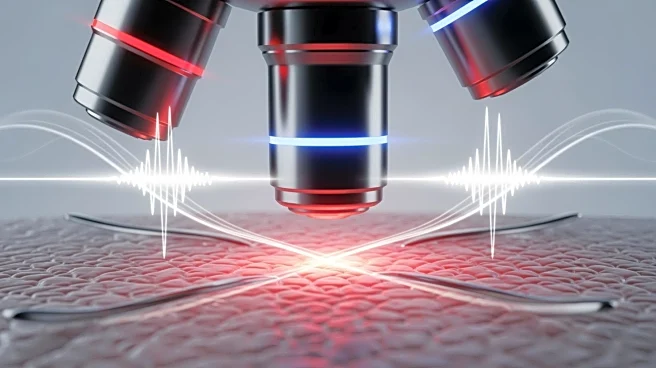
This method, known as fRSOM, allows for faster imaging, capturing up to two images per second over a 4x0.1 mm² scan area. This advancement provides detailed insights into the hyperemia process, revealing that the skin reaches peak hyperemia approximately 15 seconds faster than superficial vessels. The study involved conducting forearm PORH tests to visualize the dynamics of the microvasculature at a single capillary level. The fRSOM method offers a higher temporal resolution compared to previous methods, which were limited by slower acquisition times and motion artifacts.
Why It's Important?
The ability to capture detailed images of skin microvasculature dynamics has significant implications for medical research and diagnostics. This advancement could lead to better understanding and monitoring of microvascular endothelial dysfunction, which is a key factor in various cardiovascular diseases. By providing a more precise and rapid assessment of microvascular health, this technology could improve the diagnosis and treatment of conditions related to vascular health. Additionally, the enhanced imaging capabilities may facilitate the development of new biomarkers for assessing cardiovascular risk, potentially leading to earlier interventions and improved patient outcomes.
What's Next?
The next steps involve further validation of the fRSOM method in clinical settings to assess its efficacy and reliability in diagnosing microvascular conditions. Researchers may also explore the application of this technology in other areas of medical imaging, such as oncology or dermatology, where detailed vascular imaging could provide valuable insights. Collaboration with healthcare providers and researchers will be crucial to integrate this technology into routine clinical practice, potentially transforming the way microvascular health is assessed and monitored.
Beyond the Headlines
Beyond its immediate applications in vascular health, the advancements in optoacoustic mesoscopy could have broader implications for medical imaging technology. The ability to capture high-resolution images at a rapid pace may inspire innovations in other imaging modalities, leading to more comprehensive diagnostic tools. Furthermore, the non-invasive nature of this technology could make it a preferred choice for continuous monitoring of patients, reducing the need for more invasive procedures. As the technology evolves, ethical considerations regarding data privacy and the use of advanced imaging techniques in healthcare will need to be addressed.