

What's Happening?
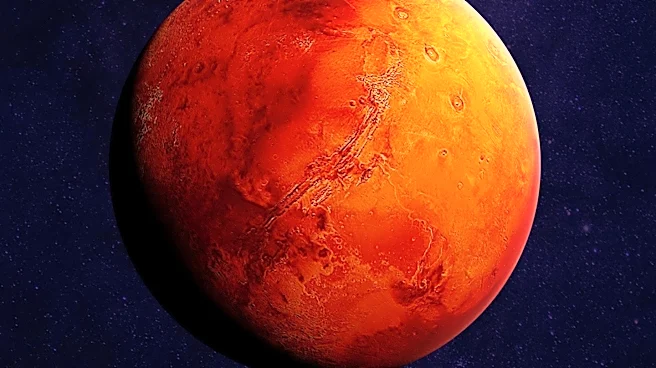
NASA's Perseverance rover has discovered organic carbon just beneath the surface of Mars, specifically in the Jezero Crater's Bright Angel formation. This finding, detailed in a new study published in Science Advances, highlights the presence of macromolecular
carbon (MMC), a form of organic carbon. The discovery was made using the SHERLOC instrument, which employs Raman spectroscopy to identify and map minerals and organic compounds. The presence of MMC is significant as it can form through both biological and nonbiological processes, leaving open the question of whether life once existed on Mars. The organic carbon was found mere microns below the surface, suggesting it is either resistant to degradation or protected by surrounding minerals. This discovery extends the map of Martian organics, with Perseverance detecting this material over 2,000 miles from previous findings by the Curiosity rover.
Why It's Important?
The discovery of organic carbon on Mars is crucial as it provides insights into the planet's past environments and the potential for ancient life. Organic carbon is a fundamental building block of life, and its presence on Mars suggests that the planet may have once had conditions suitable for life. This finding could influence future Mars exploration missions, as scientists aim to determine whether the organic carbon is of biological origin. The discovery also highlights the need for advanced laboratory analysis on Earth to conclusively determine the origins of these organic materials. If samples from Mars are returned to Earth, they could provide definitive answers about the planet's habitability and the history of organic material on Mars.
What's Next?
The next steps involve further analysis of the samples collected by Perseverance. Scientists hope to bring these samples back to Earth for more detailed examination using advanced laboratory equipment. This could help determine whether the organic carbon found is of biological origin. The findings will guide future Mars missions and research, potentially leading to new discoveries about the planet's history and its capacity to support life. The scientific community will continue to study the data collected by Perseverance to refine their understanding of Mars' geological and environmental history.