
What's Happening?
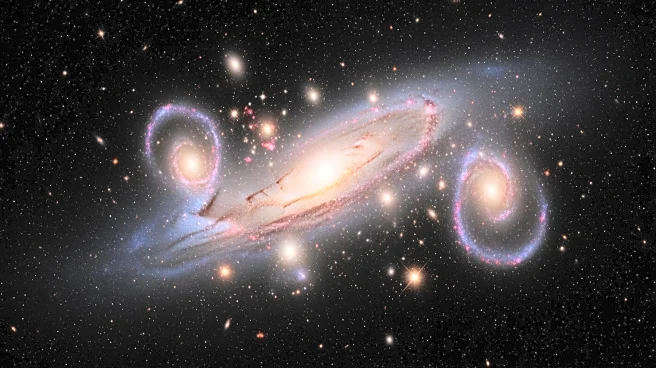
Astronomers have been closely examining 3I/ATLAS, an interstellar object, and have discovered that it behaves unlike typical comets. Recent images from December reveal a compact brightness core surrounded
by a dense, asymmetric dust environment. This structure suggests that 3I/ATLAS is not a solid nucleus with a straightforward tail, but rather a luminous envelope that obscures its true nature. The dust veil appears to be self-regulating, controlling what is visible to telescopes. This discovery challenges previous assumptions about the composition and behavior of interstellar objects, prompting further investigation into their characteristics.
Why It's Important?
The unusual behavior of 3I/ATLAS provides new insights into the nature of interstellar objects, which are relatively rare and not well understood. Understanding the composition and dynamics of such objects can offer clues about the conditions and processes in other star systems. This knowledge is crucial for developing a comprehensive picture of the universe and the diversity of celestial bodies it contains. The findings could also have implications for future space missions and the search for extraterrestrial life, as they expand our understanding of the materials and phenomena that exist beyond our solar system.
What's Next?
Astronomers will continue to study 3I/ATLAS to gather more data on its composition and behavior. Advanced imaging techniques and spectroscopic analysis will be employed to probe deeper into the object's structure. These efforts aim to determine the nature of the dust veil and the core it conceals. The findings could lead to new theories about the formation and evolution of interstellar objects. Additionally, the study of 3I/ATLAS may inform the design of future missions to explore similar objects, enhancing our ability to study the cosmos.