



What's Happening?
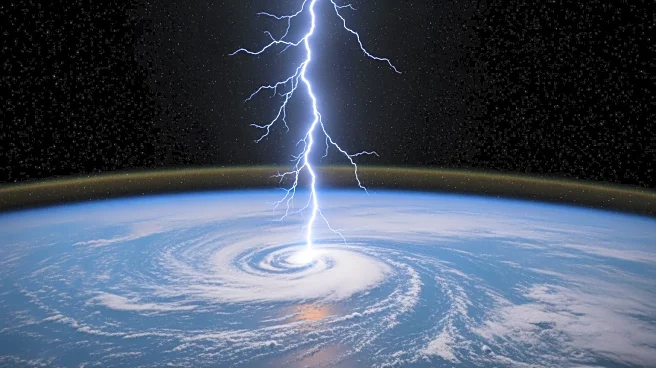
Astronauts aboard the International Space Station (ISS) have captured rare electrical discharges known as transient luminous events (TLEs) from above Earth's storm clouds. These phenomena, including red sprites, blue jets, and ELVES, occur at high altitudes
and are triggered by lightning. The European Space Agency's Atmosphere–Space Interactions Monitor (ASIM), installed on the ISS, plays a crucial role in observing these events. ASIM's instruments, including high-speed photometers and X-ray sensors, detect light and radiation from these discharges, providing new insights into their impact on Earth's atmosphere and long-distance radio communications. Additionally, the Light-1 CubeSat, developed by the UAE and Bahrain, has been launched to detect terrestrial gamma-ray flashes, contributing to global mapping of storm-driven radiation events.
Why It's Important?
The study of transient luminous events is significant as it reshapes the understanding of severe weather systems and their impact on Earth's atmosphere. By capturing these phenomena from space, scientists can better understand how storm energy travels beyond visible clouds, potentially affecting radio communications and climate processes. The data collected by ASIM and Light-1 CubeSat is crucial for improving flight safety and space weather modeling. Understanding these high-altitude discharges can lead to advancements in atmospheric science, offering insights into the spatial distribution of storm-driven radiation events and their potential disruptions to aviation and military communications.
What's Next?
Future research will likely focus on further analyzing the data collected by ASIM and Light-1 CubeSat to enhance the understanding of transient luminous events and their effects on Earth's atmosphere. Continued observations from the ISS and other space-based platforms will provide more comprehensive data, potentially leading to improved forecasting tools for power grid protection and satellite operations. The collaboration between international space agencies and the development of advanced detection technologies will play a key role in advancing atmospheric science and mitigating the impacts of these phenomena on global communications and climate.
Beyond the Headlines
The detection of transient luminous events from space highlights the importance of international collaboration in advancing atmospheric research. The involvement of multiple countries in projects like Light-1 CubeSat demonstrates the global interest in understanding these phenomena. Additionally, the use of advanced imaging technologies, such as the neuromorphic camera tested on the ISS, represents a significant technological advancement in capturing high-speed atmospheric events. These efforts contribute to a deeper understanding of the Earth's atmospheric processes and the potential long-term impacts of storm-generated electrical discharges on climate and communication systems.