








What's Happening?
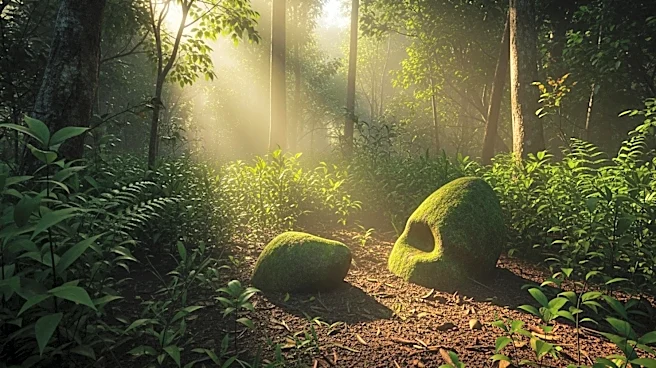
Recent archaeological findings in Côte d'Ivoire have revealed that early humans inhabited the West African rainforest approximately 150,000 years ago. This discovery, reported by ScienceDaily and conducted by researchers from the Max Planck Institute
of Geoanthropology, challenges the long-held belief that early Homo sapiens avoided dense tropical rainforests. The excavation of the Bété I site uncovered stone tools and other evidence indicating a rainforest environment, pushing back the timeline of known rainforest habitation by more than double the previous estimates. Advanced dating techniques, such as Optically Stimulated Luminescence and Electron-Spin Resonance, were used to determine the age of the artifacts. The study highlights the ecological diversity that played a crucial role in the survival of Homo sapiens, suggesting that early humans were more adaptable to various environments than previously thought.
Why It's Important?
This discovery has significant implications for understanding human evolution and the adaptability of early Homo sapiens. It suggests that early humans were capable of thriving in diverse and challenging environments, such as dense rainforests, which were previously thought to be avoided. This adaptability may have been a key factor in the survival of Homo sapiens over other human relatives. Additionally, the findings prompt a reevaluation of how long humans have been impacting rainforest ecosystems through activities like hunting and plant management. The study underscores the importance of preserving rainforests, not only for their ecological richness but also as a vital part of human history.
What's Next?
The discovery opens up new avenues for archaeological research in unexplored sites within the region, which could yield even older evidence of human habitation. Continued fieldwork, funding, and protection of these sites are essential to fill in historical gaps and further understand the role of rainforests in human evolution. Researchers may also need to reassess the timeline and extent of human influence on rainforest ecosystems, potentially leading to new conservation strategies.