






What's Happening?
Mission Blue has officially designated Singapore’s Southern Islands as a new Hope Spot, a recognition championed by Friends of Marine Park. This designation highlights an extraordinary tropical marine ecosystem where diverse marine life, scientific research,
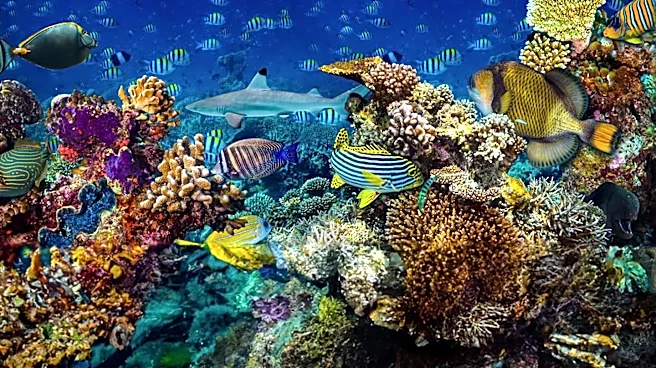
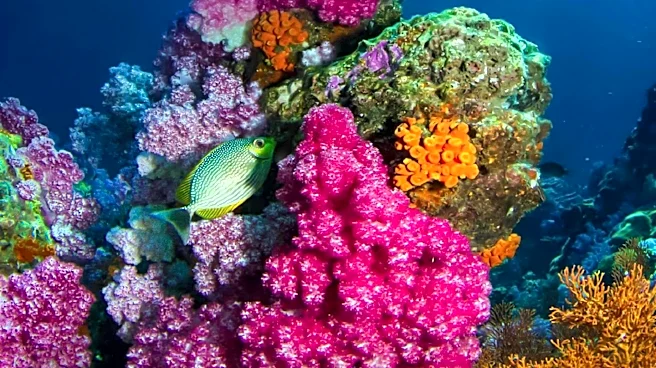
cultural heritage, and one of the world's busiest waterways converge. The recognition celebrates decades of dedicated work by Singapore’s marine community, including government agencies, scientists, and educators, to understand and conserve the nation's marine heritage. An example of these efforts is the establishment of Sisters’ Islands Marine Park, Singapore’s first marine park, which plays a crucial role in safeguarding the rich marine biodiversity and ecosystems of the Southern Islands. The area is home to over 250 species of hard coral, seagrass meadows, mangroves, reef fish, seahorses, giant clams, sharks, sponges, and critically endangered hawksbill turtles. Notably, the rare Neptune’s Cup sponge, once believed to be globally extinct, has been rediscovered in Singaporean waters, and Small Sister’s Island hosts Singapore’s only turtle hatchery for protected incubation of hawksbill turtle nests.
Why It's Important?
The designation of Singapore's Southern Islands as a Mission Blue Hope Spot is significant because it underscores the possibility of thriving marine ecosystems even in highly urbanized and industrially active coastal environments. This area, located just minutes from downtown Singapore, demonstrates that nature can persist, recover, and surprise amidst shipping lanes, coastal infrastructure, and heavily utilized marine spaces. Research indicates that the reefs around Sisters’ Islands act as vital source reefs, releasing coral larvae that can help replenish connected habitats throughout the Singapore Strait. This makes the Southern Islands a critical breeding, nursery, feeding, and movement habitat for marine life, offering a compelling model for how growing coastal cities can integrate biodiversity and build resilience for the future. The recognition also provides a platform for increased international visibility and momentum for Singapore’s marine conservation aspirations, encouraging further support for stronger and expanded marine protection efforts.
What's Next?
While the Hope Spot designation does not introduce new regulations or legal protections, it is expected to significantly boost the visibility and support for ongoing conservation efforts in Singapore's Southern Islands. Friends of Marine Park (FMP), the multi-stakeholder network championing this initiative, has outlined a three-year vision. This vision focuses on strengthening community participation, expanding educational programs and citizen science initiatives, developing youth leadership, supporting research and coral reef restoration, securing sustainable funding, and advocating for stronger and expanded marine protection across Singapore. Work is already in progress, including annual coral monitoring, community clean-ups, research programs, and educational initiatives within the marine park. The National Parks Board’s (NParks) 100k Corals Initiative is scaling up coral restoration, and Singapore’s largest artificial reef garden has been installed at Sisters’ Islands Marine Park, aiming to add approximately 1000 square meters of reef habitat by 2030. The long-term goal extends beyond the current boundaries of the Hope Spot, with champions hoping the designation will build support for broader marine protection.
Beyond the Headlines
The designation of Singapore's Southern Islands as a Hope Spot carries profound implications beyond immediate conservation efforts, highlighting a critical paradigm shift in how urbanized nations can approach environmental stewardship. It challenges the conventional notion that economic development and ecological preservation are mutually exclusive, demonstrating that even in one of the world's most densely populated and busiest coastal environments, a rich marine ecosystem can not only survive but thrive. This serves as a powerful testament to the effectiveness of sustained policy, community engagement, and scientific dedication. Ethically, it underscores humanity's responsibility to protect biodiversity even in the face of intense industrial activity. Culturally, it reinforces the connection between Singapore's maritime heritage and its natural environment, reminding former island communities and current residents of the enduring value of these waters. The success of this initiative could inspire other coastal cities globally to adopt similar integrated approaches, fostering a new era of urban planning that prioritizes ecological resilience alongside economic growth, thereby contributing to a broader global movement for ocean protection.