



What's Happening?
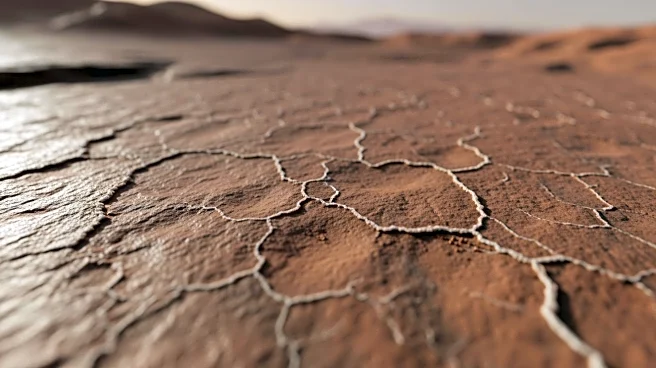
An international team of researchers has uncovered evidence of a massive ancient ocean on Mars, providing new insights into the planet's history. Using satellite data from the European Space Agency and NASA, the team studied the Valles Marineris, the largest
canyon in the solar system, and identified geomorphologic structures resembling river deltas on Earth. These findings support the theory that Mars was once a 'blue planet' with vast river systems capable of supporting life. The study, published in NPJ Space Exploration, suggests that the ocean was at least the size of the Arctic Ocean on Earth, marking a period when Mars had the largest availability of surface water.
Why It's Important?
The discovery of an ancient ocean on Mars has significant implications for understanding the planet's potential to support life. The presence of such a large body of water suggests that Mars may have had a more habitable environment billions of years ago. This finding could guide future exploration missions and inform the search for signs of past life on the planet. Additionally, the study enhances our understanding of Mars' geological history and its evolution over time, providing a clearer picture of the planet's past climate and environmental conditions.
Beyond the Headlines
The identification of ancient river deltas and oceanic features on Mars raises questions about the planet's ability to sustain life in the past. The study's findings could influence the direction of future Mars exploration missions, focusing on areas that may have been more conducive to life. Furthermore, the research highlights the importance of high-resolution satellite imagery in uncovering the planet's geological secrets. As technology advances, scientists may be able to uncover even more details about Mars' history, potentially reshaping our understanding of the solar system.